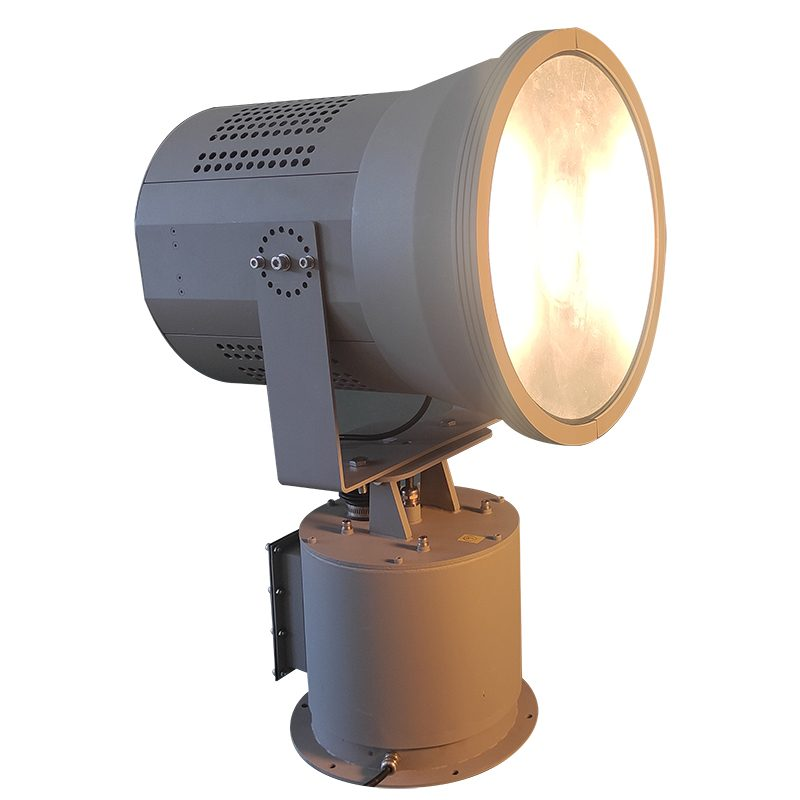
Perimeter protection for critical infrastructure—power plants, data centers, ports, correctional facilities—demands lighting that bridges the gap between continuous surveillance and instantaneous threat response. Standard flood illumination fails when operators need to isolate a moving intruder at 500 meters, in fog, or across uneven terrain. This is where a purpose-engineered searchlight for security (note: the keyword appears here for contextual clarity, not as an artificial emphasis) becomes indispensable. Unlike area lights, a security searchlight delivers a tightly collimated beam, high peak candela, and the ability to integrate directly with radar, thermal cameras, and VMS platforms.
This article examines the engineering parameters, deployment architectures, and operational pain points of modern LED-based searchlight systems. Drawing on field data and optical design principles, we provide actionable criteria for specifying a searchlight for security that maintains performance over a decade of continuous service. CAS, a specialist in high-reliability LED illumination, has contributed technical insights regarding driver design and corrosion-resistant housings, which are referenced where applicable.
1. Critical Deployment Environments for a Searchlight for Security
Understanding the physical and operational threats of each application is the first step toward selecting an effective searchlight. The following environments impose distinct mechanical, optical, and electronic requirements.
1.1 High-Security Perimeters (Airports, Seaports, Border Crossings)
These zones require searchlights that can operate with remote pan-tilt units, synchronize with secondary surveillance radar, and provide manual override during emergency lock-downs. Lighting must perform at distances from 200 m to 1.5 km, with beam divergence typically between 2° and 12°. Port environments add salt-mist corrosion risks, demanding IP66 or IP67 ingress protection plus C5-M corrosion coating.
1.2 Industrial Critical Assets (Petrochemical, Power Substations)
Explosive atmospheres (Zone 2 / Class I Div 2) may require certified searchlights. Even without hazards, substations need non-ferromagnetic housings and EMI shielding to prevent interference with sensitive relays. Thermal management becomes vital when searchlights operate in ambient temperatures up to 55°C while generating high flux.
1.3 Correctional Facilities and Deterrence Zones
Here, a searchlight for security functions as a psychological deterrent and a tactical tool. Design considerations include strobe-ready drivers (for attention-getting sequences), low-noise electronics to avoid alerting inmates, and redundant power paths to eliminate single points of failure.
2. Core Optical and Photometric Parameters in Security Searchlights
Selecting a searchlight based solely on lumen output leads to poor field performance. The critical metric is beam candela (peak intensity), which determines how far usable light can reach. The relation is governed by the inverse-square law: doubling distance reduces illuminance to one-quarter. Therefore, a security searchlight designed for 800 m of effective detection must deliver >2,500,000 cd.
Peak Beam Intensity (Candela): Minimum 1.8 Mcd for 500 m identification; 6 Mcd for 1,000 m detection (ANSI/IES TM-15-20).
Beam Angle (FWHM): Narrow beams (2°–5°) for long-range pinpointing; mixed-field optics (e.g., polygon reflectors) to create a central hot spot plus soft corona for situational awareness.
Color Temperature & CRI: Neutral white (4500K–5700K) maximizes scotopic/photopic transition; CRI >70 is sufficient for identification, but CRI >85 assists camera sensors in low-light conditions.
Photobiological Safety: Compliance with IEC 62471 (Risk Group 2 or lower) is mandatory for searchlights that can be viewed accidentally by personnel.
CAS searchlight for security models employ a multi-faceted aspheric lens array, achieving 5.2 Mcd at 180W input with a 3.5° beam. This optical efficiency reduces total fixture count along long fence lines, lowering infrastructure complexity.
3. Thermal Management and Lifespan in Continuous Operation
Security searchlights often run 12 hours nightly or 24/7 in high-threat
zones. LED junction temperatures above 85°C accelerate lumen depreciation and
cause catastrophic chromatic shift. For a design life of 60,000 hours (L70), a
searchlight for security must incorporate:
- Active cooling with sealed,
redundant fans (ball-bearing type, MTBF > 70,000 h).
- Vapor chamber or
heat-pipe interface to spread heat from COB arrays.
- External fin surface
area ≥ 300 cm² per 100W dissipated.
- Overtemperature protection that
linearly derates current before shutdown.
Field data from coastal surveillance projects show that poorly cooled searchlights lose 30% of output within 18 months due to thermal degradation. CAS integrates a thermal management controller that logs internal temperatures and adjusts PWM frequency, maintaining junction temperatures below 80°C even at 50°C ambient.
4. Smart Integration: From Standalone to Fully Networked Searchlight for Security
Modern security searchlights function as edge devices within a physical security information management (PSIM) ecosystem. Required features include:
Onboard intelligence: Auto-tracking via video motion metadata from ONVIF Profile S/M streams.
Protocol support: TCP/IP, Modbus TCP, RS-485/Pelco D, and dry-contact I/O for direct sensor triggering.
Position feedback: Absolute encoder reporting (0.1° accuracy) to allow VMS to recall presets after manual overrides.
Cybersecurity: Disable unused services, TLS 1.2 for configuration, and client certificate authentication.
A network searchlight for security can be programmed to perform “sector scans” every 2 seconds, while dwelling 300 ms on each thermal alarm point. Compared to fixed lighting, this reduces false alarms by over 40% because operators instantly see what triggered the radar or PIR sensor.
5. Industry Pain Points and Solutions
5.1 Rapid Component Failure in Humid/Coastal Zones
Problem: Internal condensation destroys drivers and corrodes LED contacts. Solution: Specify searchlights with hermetic sealing (IP66/IP67) and a Gore® membrane to equalize pressure without ingesting moisture. CAS potted drivers with conformal coating as standard.
5.2 Slow Response When Triggered by Alarm
Problem: Traditional HID searchlights need 30–120 seconds to reach full brightness. Solution: LED searchlights achieve full intensity in<150 ms.="" in="" fast-moving="" intruder="" scenarios="">
5.3 Glare and Light Trespass Complaints
Problem: Neighbors or on-site personnel complain about blinding light. Solution: Choose searchlights with asymmetric beam shaping or louver attachments. For airside ground support, use stepped dimming (100% / 50% / 10%) via remote signal.
5.4 Integration with Legacy Analog CCTV
Problem: Many sites still use analog coax cameras that cannot send PTZ commands digitally. Solution: Searchlight controllers must support analog joystick inputs and contact-closure presets. CAS provides a universal interface box that translates 0–10V or RS-422 to Ethernet commands.
6. Mechanical Construction and Environmental Certification
When a searchlight for security is mounted on a mast at a remote sub-station, maintenance is expensive and dangerous. Therefore, the housing must survive extreme weather, vibration from wind, and potential impacts.
Ingress Protection: IP66 (dust-tight, powerful jets) as minimum; IP67 required for tidal zones or wash-down areas.
Impact Resistance: IK08 (5 joule) for general use; IK10 (20 joule) for perimeters subject to vandalism.
Vibration Standard: IEC 60068-2-6 (5–500 Hz, 2g) – essential for bridge or gantry-mounted searchlights.
Material: Seawater-grade 316L stainless steel or anodized LM6 aluminum. Powder coating thickness ≥ 80 µm.
Certifications such as UL 1598 (wet location) or EN 60598-2-5 (floodlight) are non-negotiable for insurance and code compliance.
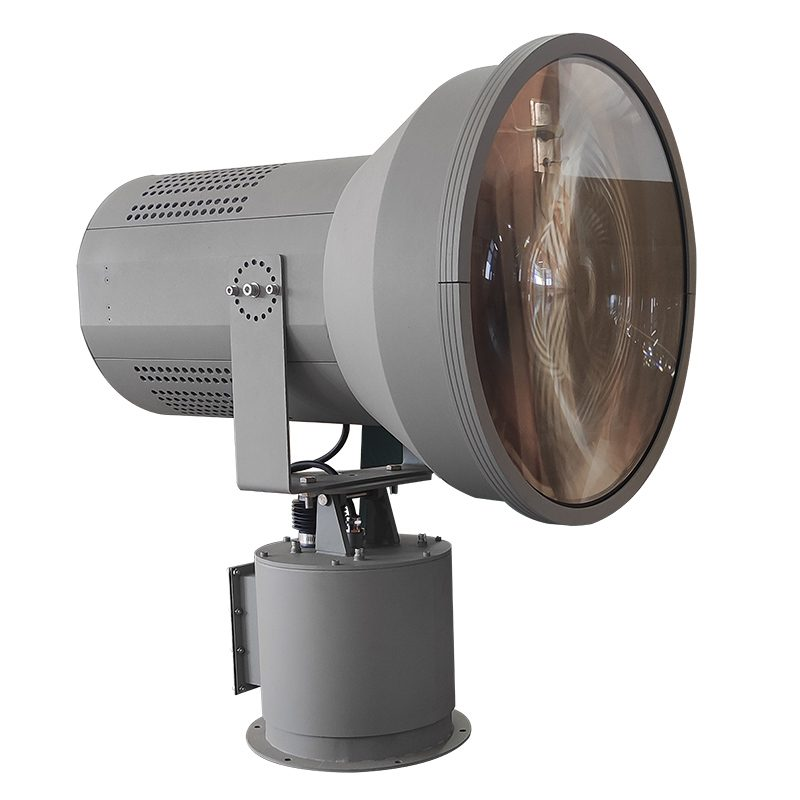
7. Operational Redundancy and Power Resilience
A single failing driver should not black out a critical searchlight. Best-practice designs incorporate:
Dual driver modules – each feeding half the LEDs. If one driver fails, the searchlight maintains 50% output.
Auto-transfer switch (ATS) for two separate AC feeds (mains + backup generator).
Integrated 24 VDC battery buffer – ensures searchlight can perform a parking movement and stay on for 20 minutes after total AC loss.
For remote sites without stable utility, a searchlight for security should accept wide-input DC (e.g., 12–48 V) directly from solar-charged banks. CAS offers a variant with internal MPPT charging control for off-grid border monitoring stations.
8. Selecting the Correct Searchlight for Security: a Technical Checklist
Use the following matrix to compare candidate fixtures. Each parameter directly affects total system effectiveness.
Peak candela at rated distance: Request an IES file. Verify that at 70% of claimed range, illuminance is ≥ 0.25 lux (enough for an HD camera to detect movement).
Beam homogeneity: Ask for a goniophotometric report. No dark spots or rainbow artifacts.
Start-up time to full lumen: Should be<200 ms="" from="" cold="" start="">
Control latency: From command to movement start ≤ 50 ms; protocol response times documented.
Mean time between failures (MTBF): Reputable manufacturers provide Telcordia SR-332 or MIL-HDBK-217F calculations. Look for MTBF > 80,000 hours for motion system and > 150,000 hours for LED engine.
Finally, weigh the total life-cycle maintenance against the initial specification. A searchlight for security with modular LED boards and field-replaceable fans reduces downtime to under 30 minutes.
9. Future Trajectories: Adaptive Searchlights and Predictive Maintenance
Machine vision and edge AI will reshape how searchlights are deployed. Emerging capabilities include:
Adaptive beam steering: Using micro-mirror arrays to redirect light without moving the whole housing, enabling near-instantaneous response to multiple threats.
LIDAR-integrated searchlights: The searchlight automatically paints a full intensity beam onto a LIDAR-detected object while keeping residual illumination low to avoid revealing guard positions.
Predictive health monitoring: Onboard sensors for vibration, driver voltage ripple, and thermal impedance. Data is sent via MQTT to a central CMMS, allowing maintenance before failure.
CAS is currently field-testing a second generation of condition-monitoring searchlights for security perimeters, with self-diagnostics for LED degradation and motor bearing wear. These units report remaining useful life (RUL) with ±5% accuracy.
Conclusion: Engineering Confidence in Security Lighting
Selecting a searchlight for security is not a commodity purchase. It demands a clear understanding of optical range, thermal limits, environmental threats, and control system integration. By prioritizing candela, ingress protection, smart protocols, and redundancy, site owners gain a lighting asset that supports 24/7 vigilance without constant intervention. CAS recommends performing an on-site lighting simulation before final procurement, especially for irregular perimeters or mixed terrain.
For projects that require a custom beam pattern, specialized mounts (pole-top, wall, or recessed), or accredited test reports, the engineering team at CAS provides consultation and rapid prototyping services. The company’s security searchlight range currently covers from 1.2 Mcd to 8 Mcd, with optional white/IR switching models.
Frequently Asked Questions (FAQs) – Searchlight for Security
Q1: How does a searchlight for security differ from a standard LED floodlight?
A1: A standard floodlight produces a wide, diffuse pattern (typically 90°–120°) meant for area illumination. A security searchlight produces a narrow high-intensity beam (often<10°) to="" project="" light="" over="" long="" distances="">
Q2: What minimum IP rating should a searchlight for security have for outdoor perimeter use?
A2: For general outdoor exposed positions (rain, dust, pressure washing), IP66 is mandatory. If the searchlight is subject to submersion (flood-prone areas, tidal docks) then IP67 or IP68 is advised. Additionally, check for UV-resistant cable glands and silicone gaskets, not just lab test results.
Q3: Can I integrate a searchlight with my existing Pelco or ONVIF-compliant VMS?
A3: Yes, most modern searchlights for security support ONVIF Profile S (for video) and Profile M (for motion/PTZ). For older Pelco D/P protocol, RS-485 interfaces are available. It is vital to request the manufacturer’s SDK or API documentation to ensure preset management and alarm binding work natively.
Q4: How do I ensure a searchlight works in fog, rain, or snow without backscatter glare?
A4: Backscatter is reduced by selecting a longer wavelength option (5800K–6200K) or dedicated yellow/amber filters. Physically, mounting the searchlight slightly offset from the operator’s line of sight (e.g., 1 m below a camera) also reduces glare. Some CAS searchlights incorporate a “fog cut” mode that reduces beam spread and toggles a diffuser lens.
Q5: What is the typical lifespan of an LED searchlight in continuous nightly operation?
A5: With proper thermal design, L70 (70% lumen maintenance) should exceed 60,000 hours, equivalent to 13.7 years of 12-hour nightly use. Driver electronics often become the limiting factor. Searchlights with isolated, surge-protected drivers (10 kV combination wave) and over-temperature de-rating regularly reach 80,000 hours before any component fails.
Q6: Can a searchlight be triggered directly from a radar system without a separate PLC?
A6: Many security searchlights include programmable logic inside the controller that accepts dry contact closure or TCP string from radar. The searchlight can perform a “goto” preset based on the radar target azimuth. Some models also include a buffered relay output to wake up cameras. CAS searchlights ship with a configurable trigger matrix.
Q7: Does a searchlight for security require special cabling for long distances?
A7: For control signals, RS-485 can extend up to 1200 m; beyond that use fiber optic media converters. Power cabling must be sized for voltage drop (typically ≤ 5% loss). Many searchlights accept 90–305 VAC or wide DC input to accommodate long runs. Always use shielded twisted pair for data lines to prevent EMI from nearby high-voltage cables.
Ready to specify the optimal searchlight for security for your infrastructure? Our technical sales team provides IES files, 3D step models, and integration guides for all CAS searchlight models. Whether you need CE/UKCA/UL certified units or a custom beam optic, send your project requirements and site layout to begin a consultation.
For inquiries, please contact CAS via the official website inquiry form or email directly at daniel.lin@zkxyled.com. Include your desired range, mounting height, and control protocol for a guaranteed response within 24 business hours.