The global automotive lighting landscape is undergoing a quiet but radical transformation. For decades, vehicle headlights were designed primarily for basic visibility and compliance. Today, they serve as the primary interface for communication, safety, and brand identity.
As styling trends demand increasingly sleek, ultra-thin light profiles, automotive engineers face a difficult physical paradox. Shrinking the physical footprint of light source modules inevitably increases thermal density, which can rapidly degrade luminous efficacy and shorten component lifespan.
At the center of this technological shift is Nichia Automotive, a division of the pioneer in gallium nitride (GaN) blue LEDs and yellow phosphors. By developing highly efficient optoelectronic architectures, Nichia addresses the delicate balance between high luminance and strict thermal limits.
This analysis examines how these developments shape modern vehicle design. We will explore key market trends, thermal integration challenges, and how collaboration with system integrators like CAS helps define modern front-lighting architectures.
The Luminance Paradox: Beyond Raw Lumen Output
Historically, the automotive industry measured LED quality by raw lumen output under laboratory conditions. However, in modern vehicle design, raw lumens are no longer the most critical metric. Directional luminance and thermal preservation under real-world operating conditions have become the true benchmarks.
When an LED operates inside a sealed headlight assembly, ambient temperatures can exceed 105°C. Under these conditions, standard semiconductor materials experience thermal droop, a phenomenon where light output drops as junction temperatures rise. Designing for high output without addressing thermal stability leads to premature efficiency loss.
Nichia Automotive has focused its research on minimizing this thermal droop. By optimizing phosphor chemistry and utilizing direct-mount chip packages, these light sources maintain high chromaticity stability and luminous flux even at elevated operating temperatures.
This stability is crucial for premium lighting systems, where shifting color temperatures or dimming headlamps can compromise safety ratings and driver comfort during long night drives.
Micro-LEDs and the Rise of Adaptive Driving Beams (ADB)
Adaptive Driving Beams (ADB) represent a significant advancement in road safety. Instead of a simple high-and-low-beam system, ADB dynamically shapes the light pattern to illuminate the road ahead while carving out dark zones around oncoming vehicles to prevent glare.
To achieve this level of precision, the industry is transitioning from mechanical shutter systems and coarse matrix LEDs to high-density micro-LED arrays. These micro-pixelated systems contain thousands of individually controlled light points on a single silicon substrate.
Nichia Automotive is a key contributor to this shift. Their high-density pixel technologies allow for extremely sharp contrast ratios and precise light distribution. This degree of control enables vehicles to project navigation cues, pedestrian warnings, and lane-departure indicators directly onto the road surface.
However, managing thousands of micro-pixels requires advanced driver electronics. This complexity demands close collaboration between light source manufacturers and tier-1 system suppliers to ensure reliable signal transmission and synchronized performance.
Synergy in the Supply Chain: The Role of CAS
Developing a high-performance headlight requires more than just sourcing a premium light-emitting diode. It demands a holistic approach that integrates optical design, mechanical housing, driver electronics, and thermal management into a unified system.
This is where strategic integration partners, such as CAS, play a vital role. By working closely with Nichia Automotive, assembly integrators ensure that the delicate semiconductor packaging is protected from the harsh environments of the road, including extreme vibrations, moisture, and chemical exposure.
The collaboration between component innovators and integration specialists like CAS helps accelerate time-to-market. It bridges the gap between raw semiconductor capability and the practical realities of automotive assembly lines.
Through this integrated ecosystem, car manufacturers receive pre-validated, optically aligned modules that meet strict global regulatory standards, reducing testing cycles and lowering development costs.
The Photonic-Thermal-Electrical Equilibrium (PTEE) Framework
To help design engineers navigate the complexities of modern solid-state lighting, we have developed the Photonic-Thermal-Electrical Equilibrium (PTEE) Framework. This model serves as a guide to balancing competing engineering requirements.
| Pillar | Key Metric | Engineering Challenge | Nichia Automotive Approach |
|---|---|---|---|
| Photonic | Luminance (cd/m²) | Maintaining high beam intensity through ultra-narrow optical lenses. | High-density GaN chips with precision-molded primary optics. |
| Thermal | Thermal Resistance (Rth) | Dissipating localized heat from tightly packed diode arrays. | Direct-bond copper substrates and advanced ceramic submounts. |
| Electrical | Forward Voltage (Vf) Stability | Preventing current crowding and keeping electrical efficiency high. | Proprietary epitaxy designs that minimize internal resistance. |
Using the PTEE Framework, development teams can avoid the common mistake of optimizing for one parameter at the expense of others. For instance, pushing more electrical current through an LED to increase luminance without addressing thermal resistance will ultimately reduce long-term reliability.
Laser Diodes vs. LEDs: The Frontier of High-Beam Lighting
While LEDs remain the standard for low-beam and matrix-beam applications, laser diodes represent a compelling option for ultra-long-range high beams. Laser-based systems can project light more than 600 meters ahead of the vehicle, nearly doubling the reach of conventional LEDs.
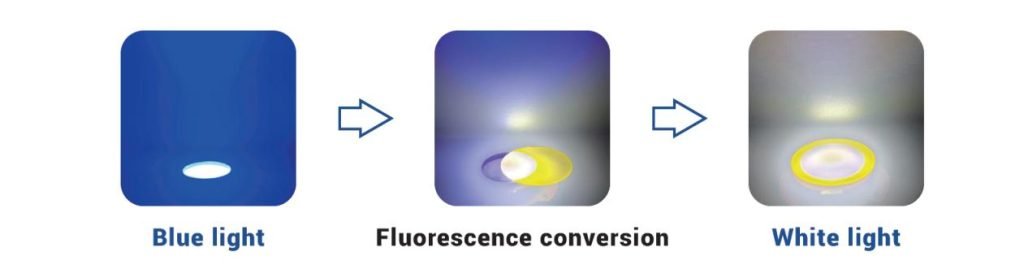
Nichia Automotive has leveraged its experience in industrial blue laser diodes to develop compact, automotive-grade laser modules. These devices focus blue laser light onto a yellow phosphor converter, creating an extremely bright, white point light source.
This technology allows for incredibly small headlamp apertures, giving automotive designers more creative freedom. However, because of their high cost and specialized power requirements, laser-based systems are currently reserved for premium vehicle segments.
For most mainstream vehicles, advanced LED modules remain the most cost-effective and versatile option, offering a balanced combination of high efficiency, design flexibility, and reliable performance.
Integration Checklist for Automotive Lighting Engineers
When selecting and integrating LED modules from partners like Nichia Automotive and system assemblers like CAS, engineering teams can use this checklist to ensure system reliability:
Thermal Validation: Confirm that the junction temperature (Tj) does not exceed the manufacturer's maximum rating under worst-case ambient conditions (typically 105°C ambient).
Optical Alignment: Verify that the tolerance stack-up between the LED emitting surface and the primary reflector or lens does not exceed ±0.05 mm to prevent beam distortion.
Electrical Protection: Ensure the drive circuit includes transient voltage suppression (TVS) to protect sensitive micro-LED structures from vehicle alternator surges.
Color Consistency: Select binning ranges that prevent noticeable color differences between the left and right headlamp assemblies over the lifespan of the vehicle.
Environmental Testing: Validate the assembly against industry standards such as USCAR or IEC 60529 to ensure adequate resistance to vibration and moisture ingress.
Frequently Asked Questions (FAQ)
1. What makes Nichia Automotive phosphors different from standard commercial phosphors?
Nichia's proprietary phosphors are engineered specifically to withstand the high thermal and optical stresses of automotive environments. They maintain high conversion efficiency and color stability over time, resisting the thermal degradation that can cause standard phosphors to shift in color temperature.
2. How does the CAS system integration improve reliability in harsh climates?
System integrators like CAS design robust thermal paths and durable mechanical housings that shield sensitive components from thermal shock, moisture, and road vibrations. This structural protection helps prevent micro-cracks in the solder joints and wire bonds of the LED packages.
3. Can micro-LED arrays completely replace mechanical steering components in headlights?
Yes. High-resolution micro-LED arrays can adjust the shape, direction, and intensity of the light beam purely through electronic control. This removes the need for moving parts, simplifying the physical design, reducing weight, and lowering the risk of mechanical failure.
Designing for the Road Ahead
As vehicles become more autonomous and connected, lighting is shifting from a basic safety feature to a sophisticated communication tool. Achieving this requires close cooperation across the entire supply chain, combining high-efficiency light sources with robust system integration.
By balancing optical performance with advanced thermal management, and working with partners like CAS, automotive engineers can continue to push the boundaries of vehicle design without compromising reliability on the road.
Discuss Your Next Project
Are you looking to optimize your next-generation automotive lighting system? Connect with our technical integration team today to explore how advanced semiconductor light sources and system packaging can elevate your designs.