Operating a commercial offshore fishing fleet demands precision engineering and strict cost control. Fuel consumption accounts for up to 50% of offshore operating expenses (OPEX). Every kilowatt generated on deck must directly contribute to vessel safety or catch volume.
For decades, commercial fleets relied on high-intensity discharge (HID) and metal halide fixtures. Today, modern maritime fleets are replacing these legacy systems with industrial LED technology. Forward-thinking vessel operators look to specialized manufacturers like CAS to modernize their optical and electrical setups.
Selecting commercial-grade overhead fishing lights is no longer just about buying the brightest fixture. It requires a detailed evaluation of marine physics, electrical architecture, and photonic biology. Below are the five critical factors fleet managers and marine contractors must evaluate for 2026 deployments.
1. Spectral Science and Penetration Depth: Target Wavelengths vs. Raw
Lumens
A persistent myth in commercial fishing is that higher lumen output guarantees a larger catch. Raw lumens measure brightness as perceived by the human eye on land. Saltwater acts as a dense physical filter that selectively absorbs and scatters light across different wavelengths.
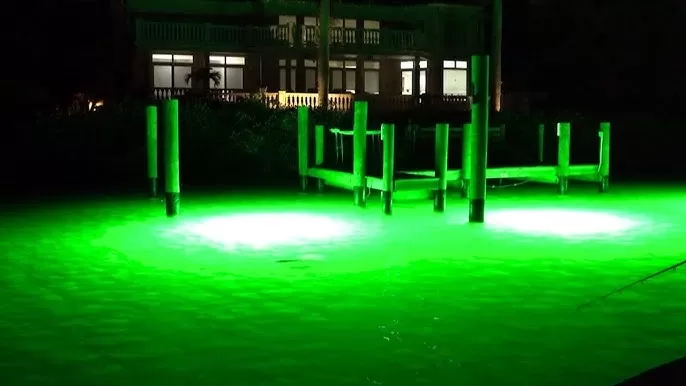
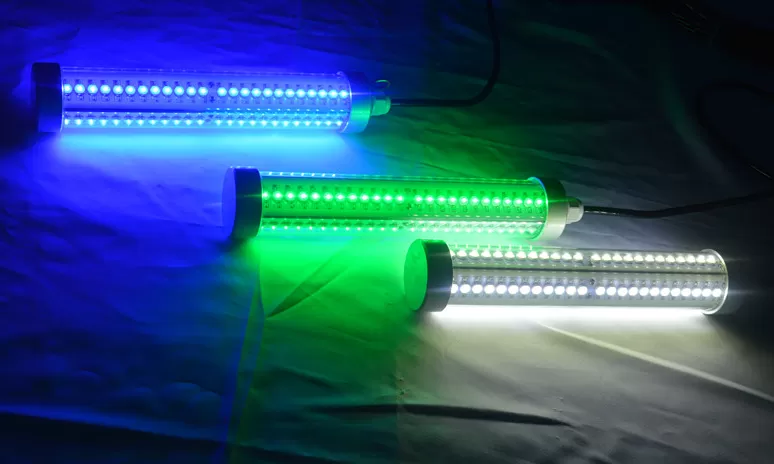
Red, yellow, and orange light waves degrade rapidly within the first 5 to 10 meters of the water column. In clear pelagic waters, blue wavelengths between 450nm and 480nm penetrate deepest. Coastal and estuarine waters containing organic runoff and phytoplankton favor green wavelengths between 500nm and 530nm.
Commercial marine species possess specialized photopic vision tailored to their depth brackets:
Squid (Cephalopods): Highly sensitive to narrow-band blue-green wavelengths (470nm-495nm) that trigger phototaxis in forage prey.
Pelagic Predators (Tuna, Mackerel): Attracted by contrast edges created where ambient downwelling light meets the artificial beam.
Clupeoids (Sardines, Anchovies): Rapidly respond to broad-spectrum green light for school compaction.
In 2026, leading overhead fishing lights feature dual-wavelength or tunable spectrum controls. Instead of operating fixed single-color rigs, fleet masters can modulate the output spectrum between 450nm and 520nm directly from the bridge. Matching the emitted spectrum to regional water turbidity maximizes photic penetration. This precision directly drives up your catch per unit effort (CPUE) while avoiding wasted optical energy.
2. Marine-Grade Ingress Protection and Thermal Management
High seas subject vessel hardware to extreme physical punishment. Commercial overhead fishing lights face constant salt spray, vibration from main diesel engines, green water over the bow, and intense UV radiation. Fixture failure mid-season disrupts operations and drives up total cost of ownership (TCO).
Fleet operators must look beyond standard industrial specifications and demand true marine-grade hardware:
Structural Materials: Low-copper die-cast aluminum alloys must have electrostatically applied fluorocarbon or powder coatings rated for over 1,000 hours of ASTM B117 salt spray testing. For severe corrosive environments, passivated 316L stainless steel hardware is non-negotiable.
Ingress Protection: Look for dual ratings. An IP67 rating ensures survivability during temporary submersion, while an IP69K rating guarantees the housing withstands high-pressure, high-temperature washdowns during deck cleaning.
Mechanical Impact Resistance: Fixtures must carry an IK09 or IK10 mechanical impact rating to survive swinging tackle, heavy swells, and offshore handling accidents.
Heat dissipation is equally critical. LED junction temperatures directly dictate luminous decay and diode lifespan. Enclosed fixtures exposed to tropical deck temperatures can cook internal components if heat sinks are undersized.
Modern commercial fixtures use copper vapor chambers or graphene-infused thermal interfaces. These passive thermal systems pull heat away from the diode array without external fans, which inevitably fail in salt air. Thermal designs engineered by CAS maintain diode junction temperatures well below 75°C under continuous operational loads. This thermal stability prevents optical shifting and extends continuous operating life past 60,000 hours.
3. Electrical Architecture, Luminous Efficacy, and Fuel Economics
Every watt consumed by your deck lighting places continuous load on the auxiliary diesel generators. Auxiliary fuel burn represents a substantial recurring expense on extended pelagic journeys. Replacing inefficient lighting directly lowers fuel consumption.
Legacy metal halide bulbs typically deliver an actual system efficacy of 60 to 80 lumens per watt (lm/W) after thermal losses, with substantial omnidirectional light loss. Contemporary commercial-grade overhead LED systems exceed 150 to 170 lm/W in useful directional output.
Consider the economic impact across an active harvesting season:
Power Reduction: Replacing forty 1,000-watt metal halide units with forty 400-watt high-efficiency LED units reduces the electrical load from 40 kW to 16 kW.
Fuel Savings: Over a 10-hour night run during a 180-day operating campaign, this 24 kW load reduction saves approximately 10,800 to 12,000 liters (2,800 to 3,100 gallons) of marine diesel.
Generator Wear: Lower generator loads extend service intervals, reduce oil consumption, and decrease unexpected electrical failures far offshore.
Vessel electrical grids are notoriously unstable. Heavy industrial loads like hydraulic winches, blast freezers, and thrusters introduce severe voltage sags and inductive spikes. Overhead fishing lights must use heavy-duty isolated industrial drivers featuring:
Wide-range input flexibility (such as 90-305VAC 50/60Hz, or commercial DC configurations like 12-32VDC).
A high Power Factor (PF > 0.95) with Total Harmonic Distortion (THD) under 10% to prevent grid interference with onboard sonars and fish finders.
Integrated 6kV to 10kV surge suppression to absorb electrical spikes without blowing the LED array.
4. Optical Distribution, Cutoff Angles, and Deck Safety
Improper beam angles waste optical energy and create working hazards for your crew. Symmetric wide-flood beams scatter light across wet decks, causing blinding glare that impairs visibility and increases the risk of accidents during deck operations.
Effective commercial overhead fishing lights use custom-engineered asymmetric optical lenses. These optics direct photons away from the working deck and outward over the gunwales into the target marine harvesting zone.
Professional optical layouts focus on three specific engineering parameters:
Hard Cutoff Shielding: Deep recessed housings and visor visors keep the bright LED surface out of the crew's line of sight, preventing night-blindness during sorting, hauling, and offloading.
Focused Water-Surface Penetration: Asymmetric forward-throw lenses direct the primary light beam into the water at angles between 45 and 65 degrees. This minimizes surface reflection and maximizes downward light penetration.
Environmental and Wildlife Protection: Stray horizontal light attracts seabirds, which can strike vessel superstructures or foul fishing lines. Precision beam cuts contain the optical envelope, ensuring compliance with global maritime environmental standards.
5. Classification Compliance, Modular Maintenance, and OEM Support
Procurement for commercial fleets requires reliable supply chains and certified hardware. Installing uncertified or consumer-grade floodlights on commercial vessels invites regulatory scrutiny, insurance invalidation, and costly downtime.
Verify that your marine lighting vendor satisfies international commercial standards:
Marine Safety and Compliance: Fixtures must carry full CE, RoHS, and FCC Title 47 Part 15 (Class A) compliance, preventing electromagnetic interference (EMI) with satellite communications, radar, and acoustic sonars. Alignment with major classification societies (such as DNV, ABS, or BV) is strongly recommended for deep-sea vessels.
Modular Field Serviceability: If a light fails offshore, the crew cannot send it to a mainland repair depot. Commercial fixtures must offer separate, modular driver boxes connected via quick-disconnect marine cables. A crew member should be able to swap out an electronic driver or LED engine in under five minutes using basic deck tools.
Direct OEM Customization: Industrial fishing vessels rarely use identical mounting arrangements. Choose an experienced manufacturer like CAS that offers custom brackets, variable beam angles, custom DC/AC power configurations, and extended 5-year hardware warranties.
Frequently Asked Questions
Q1: How do overhead LED fishing lights compare to submersible fishing lights?
A1: Overhead fishing lights cover a significantly wider surface footprint, making them ideal for broad schooling and aggregating pelagic species around the vessel perimeter. Submersible lights offer deep localized illumination without surface reflection losses, but they face high risks of net entanglement and require careful handling during retrieval. Most commercial fleets combine both: overhead fixtures pull schools from wide areas, while submersibles concentrate the catch directly beside the collection gear.
Q2: Why is blue and green light preferred over white light for squid and pelagic attraction?
A2: White light combines all wavelengths across the visible spectrum, meaning much of its energy is lost as red and yellow light that water quickly absorbs near the surface. Monochromatic blue (450nm-480nm) and green (510nm-530nm) match the optical transmission windows of seawater. Target species possess visual receptors tuned to these wavelengths, making monochromatic beams far more effective at attracting schools with significantly lower electrical power.
Q3: Will LED deck and fishing lights interfere with vessel electronics and sonar?
A3: Poorly shielded commercial fixtures can cause electromagnetic interference (EMI) that disrupts VHF radios, AIS, GPS, and echo sounders. High-grade commercial fixtures are engineered with shielded driver enclosures, filtered circuitry, and ferrites that comply with FCC Part 15 Class A and CISPR 15 marine standards, ensuring zero interference with sensitive wheelhouse navigation and acoustic gear.
Q4: Can we use existing wiring runs when converting from metal halide to overhead LED lights?
A4: Yes. Because modern LED systems draw between 40% and 60% less amperage than equivalent metal halide fixtures, your existing deck wiring and circuit breakers can easily handle the load. However, you should thoroughly inspect older vessel wiring for insulation rot, saltwater ingress, and undersized grounding before commissioning a new LED array.
Q5: What is the typical return on investment (ROI) timeframe for a commercial LED retrofit?
A5: Most commercial vessels achieve complete capital payback within 8 to 14 months of continuous operation. This financial return comes from three areas: reduced auxiliary generator diesel consumption, the elimination of recurring metal halide bulb and ballast replacements, and higher catch efficiency driven by species-specific optical spectrums.
Secure Your Fleet's Competitive Advantage
Commercial fishing margins are directly tied to harvest efficiency and operating overhead. Outfitting your fleet with outdated, power-hungry lighting directly cuts into seasonal profits. By upgrading to engineered overhead fishing lights with species-matched spectrums, rugged marine housings, and high luminous efficiency, you protect your crew and reduce long-term fuel costs.
CAS provides engineered marine illumination systems built for demanding commercial fishing environments. Contact our commercial maritime engineering team today to receive a customized Dialux vessel lighting simulation and a comprehensive ROI audit for your fleet.
Direct Inquiries: daniel.lin@zkxyled.com | Technical Services: +86-0591-62097869