A single high-bay failure thirty feet in the air wipes out the profit margin of an entire lighting retrofit. When commercial fixtures fail prematurely, the blame almost always falls on the Chip-on-Board (COB) light source. Luminaire manufacturers cannot afford ambiguous data sheets or speculative lifespans.
Specifying engineers and procurement managers demand verified durability. This is where an authentic Lm80 Cob test report makes or breaks your commercial success. At CAS, we engineer high-density LED packages designed to withstand extreme thermal conditions while providing bulletproof documentation for project tenders.
If you are developing new commercial fixtures or bidding on high-specification tenders, you need test reports that stand up to regulatory audits. Contact the CAS engineering support desk today to request certified LM-80 test records and TM-21 calculation sheets for your optical designs.
1. Why LM-80 for COB is Completely Different from Mid-Power LEDs
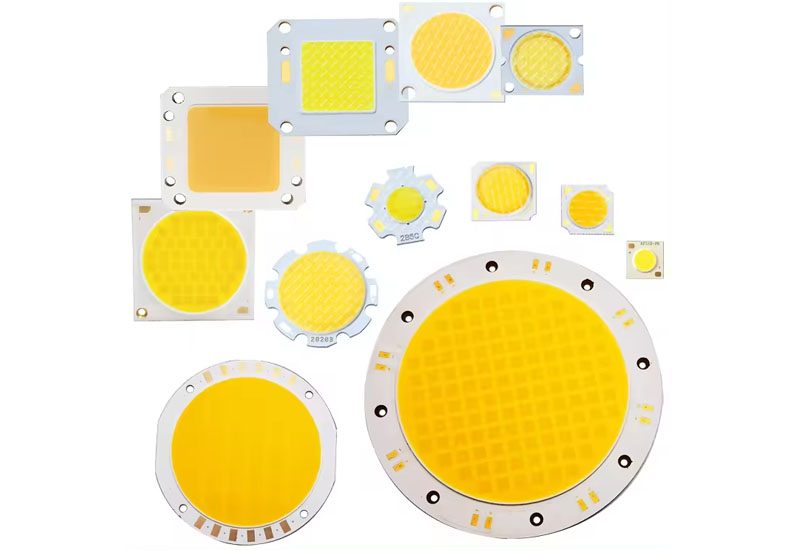
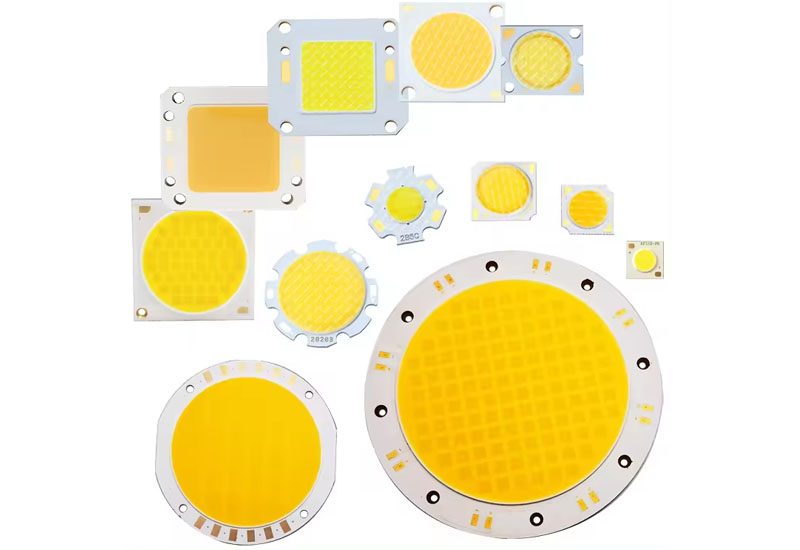
Mid-power LEDs distribute heat across dozens of discrete packages spread wide across a printed circuit board. In contrast, a COB array packs dozens, sometimes hundreds, of LED dies into a tight Light Emitting Surface (LES). This concentration generates extreme thermal flux density that pushes packaging materials to their physical limits.
Because the thermal density is concentrated into a small footprint, local junction temperatures ($T_j$) surge quickly. Standard mid-power SMD testing practices do not apply here. A generic Lm80 Cob test report must account for localized thermal stress points that simply do not exist in low-power lighting.
The failure modes of COB arrays also differ significantly from plastic-packaged surface-mount devices:
Phosphor Matrix Degradation: The high photon flux and concentrated heat accelerate binder degradation. Silicone encapsulants crack or turn yellow under sustained thermal abuse, causing severe lumen depreciation.
Substrate Thermal Fatigue: Standard aluminum substrates can suffer dielectric layer breakdown over thousands of thermal cycles. High-performance arrays utilize direct-plated copper on ceramic substrates (like Alumina or Aluminum Nitride) to maintain heat transfer integrity.
Bond Wire Fatigue: Thermal expansion mismatches between the submount, adhesive, and dies put mechanical stress on internal gold or silver wire bonds. Micro-cracks develop over repeated power cycles, leading to sudden open-circuit failures.
Die-Attach Delamination: Solder voids or resin dry-out under individual dies create micro-hotspots. Once a localized hotspot forms, die junction temperatures spike beyond rated limits, triggering rapid catastrophic failure.
2. Anatomy of a COB LM-80 Report: What B2B Buyers Must Inspect
Interpreting a COB LED reliability testing standard report requires looking past the summary page. Shrewd procurement teams dissect the raw data to ensure the testing parameters actually match their fixture's operating environment. Here are the four critical data sections you must inspect before signing off on a supplier component.
Three Mandatory Case Temperatures
The IES LM-80 standard requires testing at a minimum of three case temperatures ($T_s$). The baseline temperatures are historically 55°C and 85°C. However, modern commercial luminaires run hot inside compact housings.
For high-output commercial fixtures in 2026, the third temperature point is critical. Insist on a third temperature of 105°C or 115°C. If a supplier only tests up to 85°C, you cannot legitimately claim TM-21 extrapolations for modern, heat-restricted high-bay or track light designs.
Thermocouple Attachment Point Verification
Where did the testing laboratory measure the solder point temperature ($T_s$)? This is the easiest place for substandard manufacturers to fake reliability data.
On an authentic LM-80 test report for COB LEDs, the thermocouple must be attached directly to the manufacturer's designated temperature measurement point ($T_s$ point). This point sits directly adjacent to the silicone retention dam on the copper track. If a lab places the probe at the outer corner of the aluminum submount, the measured temperature can read 10°C to 15°C cooler than the true operational core.
Drive Current Versus Luminaire Output
Confirm the forward drive current ($I_f$) used during testing. A test run at 700mA tells you nothing about performance if your luminaire driver pushes 1050mA or 1400mA to hit target lumens.
Pushing current increases flux density exponentially. Ensure the test report demonstrates continuous operation at or above your maximum intended drive current. Overdriving an LED beyond its tested LM-80 current voids your lifespan claims in commercial audits.
Chromaticity Shift ($\Delta u'v'$)
Lumen maintenance tells only half the story. In hospitality, retail, and museum lighting, a color shift occurs long before the light goes dark. Fixtures that drift from warm white to an unappealing green or pink ruin high-end installations.
The LM-80 report must document chromaticity maintenance across all testing intervals. Ensure that the total shift ($\Delta u'v'$) remains strictly below 0.003 or 0.004 over 6,000 to 10,000 hours. This guarantees that your fixtures stay comfortably within a 3-step or 5-step MacAdam ellipse throughout their working life.
3. The Math Behind the Life: How to Extrapolate COB Lifetime via TM-21
LM-80 does not measure total lifespan; it simply gathers decay data over an extended test window. To project long-term durability, engineers apply the ANSI/IES TM-21 extrapolation method. This mathematical model fits an exponential curve to the empirical LM-80 test points.
The core formula utilizes an Arrhenius-based exponential decay equation:
L(t) = B × exp(-αt)
Where L(t) represents the remaining lumen maintenance percentage at time t, B is the projected initial lumen output ratio, and α is the decay rate constant derived through least-squares curve fitting. CAS subjects all packaging designs to stringent burn-in intervals to ensure our calculated decay rates remain among the lowest in the market.
The Critical 6x Rule
TM-21 imposes strict limits on forward projections to prevent misleading claims. You can only project a fixture's lifetime to a maximum of six times the actual hours tested in the laboratory.
6,000 hours of testing allows a maximum TM-21 claim of 36,000 hours.
10,000 hours of testing allows a maximum TM-21 claim of 60,000 hours.
Any supplier claiming an L70 lifetime of 100,000 hours based on a 6,000-hour test report violates international standards. Your DLC submissions will face immediate rejection if your data breaks the 6x limit.
Worked Example: Industrial High Bay TM-21 Calculation
Consider an industrial high bay using an array operating at a measured field temperature of $T_s = 85^\circ\text{C}$ with a drive current of 1050mA. The underlying Lm80 Cob dataset contains 10,000 continuous test hours.
| Parameter | Tested Value | Analysis & Compliance |
|---|---|---|
| Base LM-80 Test Duration | 10,000 Hours | Exceeds minimum standard requirement (6,000 hrs) |
| Case Temperature ($T_s$) | 85°C | Direct match to luminaire operating environment |
| Drive Current ($I_f$) | 1050 mA | Matches driver electrical configuration |
| Decay Rate Constant (α) | 2.84 × 10⁻⁶ | Calculated via exponential curve fit |
| Projected L70 Lifetime | > 60,000 Hours | Capped at 6x rule limit (Reported as >60k hrs) |
| Calculated L90 Lifetime | 38,200 Hours | Provides dependable data for project warranty sheets |
| Chromaticity Shift ($\Delta u'v'$) | 0.0028 at 10,000 hrs | Well within the 0.004 DLC threshold |
4. Strategic Value for Luminaire OEMs: Why Compliant LM-80 Data Wins Tenders
Securing project specifications requires verified compliance, not unsupported marketing promises. Transparent engineering documentation serves as a direct competitive advantage in enterprise lighting bids.
Passing DLC Qualification Hurdles
To qualify for North American commercial utility rebates, fixtures must gain listing on the DesignLights Consortium (DLC) Qualified Products List (QPL). The DLC 5.1 technical requirements enforce strict lumen maintenance and color stability metrics.
Submitting an unaccredited or sloppy report leads to immediate administrative rejection. A fully compliant DLC qualified COB LED LM-80 report issued by an accredited laboratory allows your applications to clear validation smoothly without redesigns or delays.
Legal Protection for Long-Term Warranties
Municipalities and corporate enterprises routinely require 5-year, 7-year, or 10-year comprehensive luminaire warranties. If an LED batch fails during year four, your business faces massive financial exposure.
When you build your lighting systems on verified components backed by authentic testing, you hold a legally recognized defense. You prove due diligence in engineering, ensuring component suppliers remain accountable for unforeseen batch defects.
Thermal Management Optimization
An authentic test dataset guides your mechanical enclosure and heatsink design. By knowing the precise relationship between $T_s$ and optical decay, your structural engineers avoid over-engineering heavy, expensive aluminum heat sinks. Designing precisely to thermal performance thresholds reduces material mass and cuts shipping freight fees across thousands of shipped units.
5. 2026 Outlook: Future Trends in COB Reliability Standards
LED engineering does not stand still. As commercial installations demand higher outputs from smaller physical apertures, packaging standards continue to evolve.
First, ceramic substrates and Flip-Chip CSP-COB designs are displacing traditional wire-bonded packages in demanding applications. By eliminating gold wire interconnects, these architectures eliminate a major failure point. However, testing these ultra-dense arrays requires updated test fixtures capable of absorbing thermal loads that exceed 50 Watts per square centimeter.
Second, major infrastructure projects are tying reliability directly to embodied carbon metrics. A fixture designed to run reliably for 80,000 hours cuts long-term raw material churn in half. Verified longevity documentation is becoming a pillar of corporate ESG compliance and circular manufacturing standards.
Frequently Asked Questions
Q1: Can I use an LM-80 report from a single-die package to qualify my COB luminaire?
A1: No. Certification bodies such as DLC and UL will reject the application. An Lm80 Cob report must evaluate a complete array package. The thermal dynamics, packing density, and encapsulant stresses in a COB are fundamentally different from single-die SMD packages.
Q2: How do I know if an LM-80 test report is legitimate and untampered?
A2: Check that the testing laboratory holds NVLAP accreditation (or regional equivalent ILAC-MRA status like CNAS) specifically for IES LM-80 standards. Look up the lab accreditation number. Furthermore, verify that the tested part number matches your component datasheet, and confirm the test report features a traceable document verification code.
Q3: What is the minimum testing duration required for TM-21 calculations?
A3: The absolute minimum testing period required by standard TM-21 processing is 6,000 hours, logged at intervals no greater than 1,000 hours. However, 10,000 hours is preferred across the industry, as it allows manufacturers to formally claim a 60,000-hour operational life under the TM-21 6x limit.
Q4: Why does color shift matter if the COB still delivers acceptable lumen output?
A4: In architectural, commercial retail, and corporate office spaces, visual consistency is paramount. If one group of downlights drifts yellow while another drifts blue, the lighting environment looks defective. DLC 5.1 rules reject fixtures that experience excessive chromaticity shift, even if total light output remains acceptable.
Q5: How does the driver current affect TM-21 projections?
A5: TM-21 rules do not permit you to extrapolate performance data to operating currents higher than the current applied during the LM-80 laboratory test. If you test at 700mA, you cannot validate lifetime performance for a luminaire running at 1050mA. You must either test at the higher current or derate your fixture output.
Source Reliable Components with Certified Performance
High-reliability commercial lighting requires absolute component transparency. Cutting corners on component verification risks unexpected field recalls and severe damage to your brand reputation. CAS provides fully certified, lab-validated LED sources engineered specifically to withstand punishing commercial duty cycles.
Ready to elevate your fixture reliability? Reach out to our technical sales engineers right now to evaluate our certified component data and secure your supply chain.