Large-scale sports field illumination demands an uncompromising balance between ultra-high luminous flux, rigorous optical control, and physical endurance. As arenas transition from high-intensity discharge (HID) metal halide systems to solid-state luminaires, the architectural path of illumination hardware has diversified. Among these methodologies, the development of the Cob Sports Lamp represents a distinct paradigm shift in how photon generation, thermal dissipation, and dynamic lighting controls converge across large-area athletic infrastructure.
Designing modern sporting venues requires meeting severe photometric criteria mandated by international athletic federations and broadcast standards. Illuminance uniformity, vertical lux levels for three-dimensional tracking, Unified Glare Rating (UGR) limitations, and high-frame-rate television capture tolerances demand extreme technical precision. Achieving these standards hinges on fundamental optoelectronic packaging decisions at the circuit board level.

Chip-on-Board versus Discrete Surface-Mount Devices in High-Lux
Applications
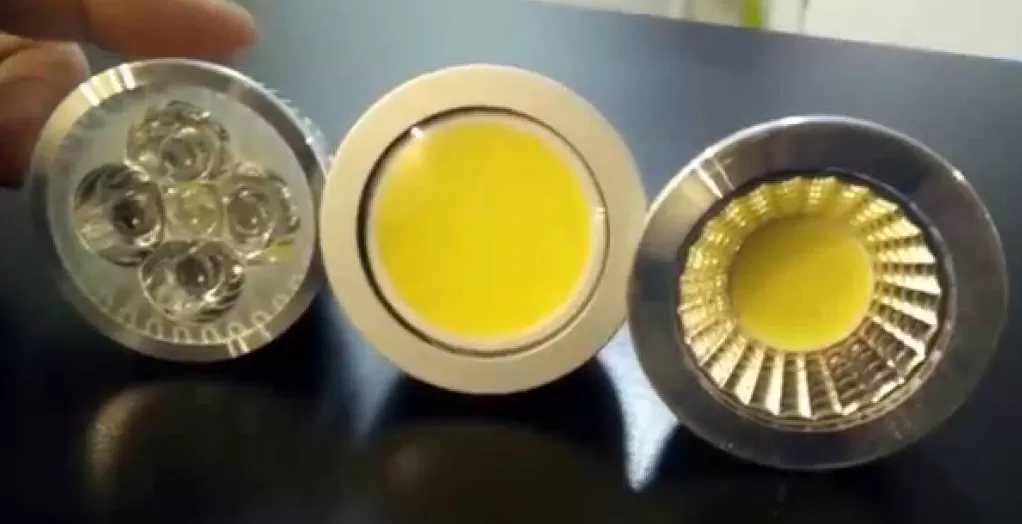
High-mast field lighting historically deployed large matrices of mid-power or high-power Surface-Mount Device (SMD) chips to achieve lumen outputs exceeding 100,000 lumens per fixture. While SMD layouts distribute heat across an expansive printed circuit board area, they present substantial challenges in optical beam concentration, color uniformity across beam angles, and optical packaging volume. Discrete packages necessitate individual lenses or complex multi-cavity arrays, which frequently introduce secondary beam artifacts, scattered spill light, and elevated optical transmission losses.
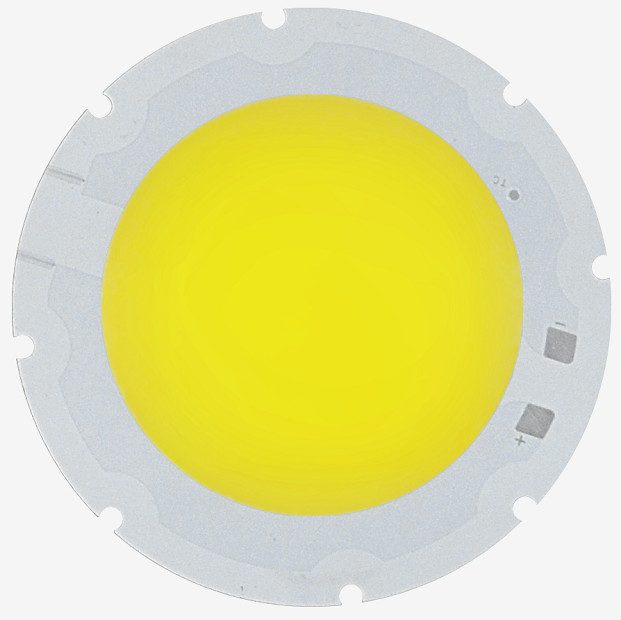
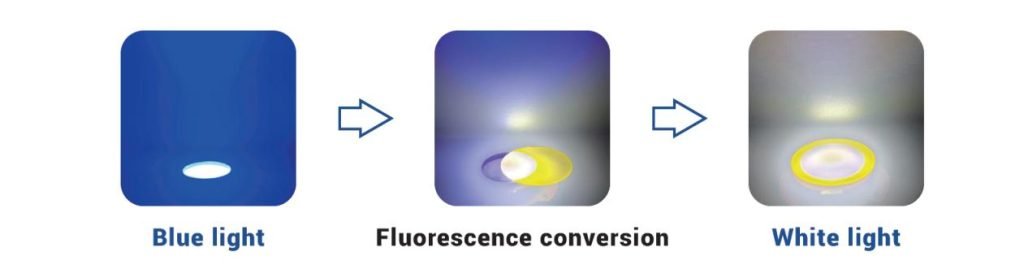
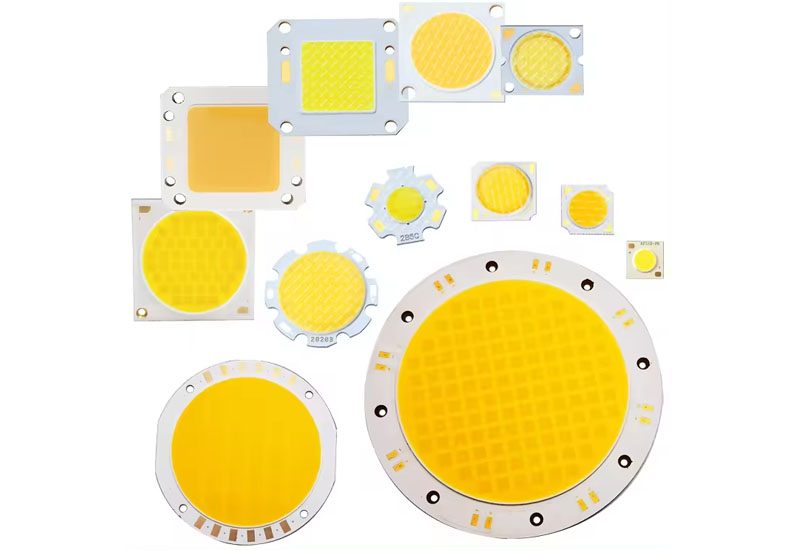
A Chip-on-Board architecture solves these micro-optical aberrations by binding an array of bare semiconductor dies directly to a substrate in immediate contact with a metal core or ceramic baseplate. By concentrating hundreds of emitter junctions under a single continuous phosphor layer, the source mimics a true point source much closer than an extended SMD grid can achieve. In sports lighting applications where light must be thrown across distances of 40 to 120 meters, optical beam narrowness and beam edge precision dictate system efficiency. Concentrated flux density permits primary and secondary optics to capture a higher percentage of raw lumens, focusing the beam into clean NEMA classifications (Type 1 through Type 4) with sharply attenuated cutoff angles.
Stadium environments feature athletes constantly tracking objects against high-mast backdrops. Deploying an integrated Cob Sports Lamp mitigates the common multiple-shadowing effect—frequently called the "disco effect"—characteristic of separated multi-emitter SMD plates. The single, uniform apparent light-emitting surface (LES) projects smooth, homogenous shadows onto the playing surface, preserving spatial perception for players and spectators while eliminating chromatic fringing along the illuminated periphery.
Thermal Architecture of the Modern Cob Sports Lamp
Thermal management is the premier operational bottleneck in high-wattage solid-state luminaire engineering. Because high-density arrays group dozens of watts per square centimeter of substrate area, heat density reaches extreme levels. Operating junction temperatures ($T_j$) must remain below critical thresholds to prevent accelerated phosphor browning, package delamination, and rapid chromaticity shift over the system's operational lifespan.
Luminaires developed through CAS optoelectronic protocols prioritize the minimization of total thermal resistance across every structural interface ($R_{\theta j-a}$, from junction to ambient). The architectural path bypasses traditional thermal design constraints through direct structural integration:
Direct-to-Substrate Die Bonding: Emitter dies sit directly on high-conductivity ceramic carriers such as Aluminum Nitride (AlN) or direct bonded copper (DBC) substrates. AlN demonstrates a thermal conductivity reaching up to 170–200 W/m·K, vastly outperforming standard glass-reinforced epoxy (FR4) and entry-level insulated metal substrates (IMS).
Vapor Chamber and Phase-Change Heat Pipes: High-flux arena fixtures utilize enclosed two-phase cooling mechanisms embedded directly behind the substrate. Saturated working fluid vaporizes at the heat source, travels rapidly across the chamber to finned condensation zones, and cycles back through capillary action within sintered copper wicks. This creates an essentially isothermal baseplate that eliminates local hot-spots.
Cold-Forged High-Purity Aluminum Heat Sinks: Instead of standard die-cast alloys (such as ADC12, which typically exhibit thermal conductivities around 96 W/m·K), the modular platform architectures utilized by CAS integrate cold-forged 1070 aluminum components delivering thermal conductivity near 226 W/m·K. The structural grain alignment of forged aluminum accelerates conductive energy transport into the convective cooling fins.
Aerodynamic Convective Topologies: Fin geometries are spaced and aligned to promote passive convective airflow under varying fixture tilt angles. Dust accumulation slots and self-cleaning water channels prevent the build-up of organic debris, preventing the thermal choking that typically degrades passive luminaires in outdoor sporting complexes.
Optical Beam Shaping, Glare Mitigation, and Broadcast Compliance
Raw lumen output provides zero utility if light is misdirected into surrounding residential zones or directly into the eyes of competing athletes. Precision beam guidance relies heavily on the design of the reflector and refractive elements paired with the high-density light-emitting surface.
Reflector Cavity and TIR Hybrid Optics
To control light emitted across a broad Lambertian distribution from the substrate, optical engineers deploy hybrid assemblies combining vacuum-metallized parabolic reflectors with secondary Total Internal Reflection (TIR) acrylic or optical-grade silicone lenses. High-grade optical silicone lenses withstand massive continuous photon density and high operating temperatures without yellowing under prolonged ultraviolet radiation exposure. By configuring a Cob Sports Lamp setup with specialized secondary micro-reflector arrays, engineers achieve exceptionally tight center-beam candlepower (CBCP) alongside field angles that restrict glare to UGR values well below the maximum thresholds permitted by professional leagues.
Television Broadcasting and Flicker Dynamics
Modern sports facilities are essentially massive multimedia broadcast studios. Ultra-high-definition (UHD), 4K, and 8K television networks rely on high-speed slow-motion cameras operating at capture rates from 300 to over 1,000 frames per second. Lighting systems with unstable output create severe visual strobe banding during playback.
Achieving compliance with the Television Lighting Consistency Index (TLCI-2012) and the European Broadcasting Union (EBU) metrics requires spectral continuity. The spectral power distribution (SPD) must feature a balanced ratio across the visible spectrum, avoiding significant blue-spike bias while maintaining a Color Rendering Index ($R_a$) greater than 80 or 90, alongside a positive $R_9$ value for vibrant rendering of skin tones and turf greens. Electrical drive current must feature a flicker factor of less than 0.2%, driven by specialized circuits that suppress alternating current ripple across high switching frequencies.
Industrial Electrical Infrastructure and System Controls
The electronic drivers powering arena luminaires operate under severe conditions, including seasonal temperature extremes, lightning strikes on exposed high-mast towers, and heavy utility load switching. An industrial-grade electrical backbone ensures that system performance remains reliable across decades of operation.
Solid-state drivers must incorporate multi-stage surge protection devices (SPD) capable of handling common-mode and differential-mode transient surges up to 10kV/20kA, often augmented by supplementary external surge suppressors located within the mast base junction panels. Total Harmonic Distortion (THD) must remain below 10% under full and throttled load conditions, with an operational Power Factor (PF) exceeding 0.95 to eliminate phase inefficiencies across large commercial utility meters.
Dynamic control protocols bridge individual luminaires into cohesive arena-wide control networks. Digital Multiplex (DMX512) and Remote Device Management (RDM) systems allow microsecond-level synchronization across hundreds of fixtures. This provides lighting directors the capability to transition instantaneously between training modes, broadcast-tier competitive play, and pre-programmed theatrical light shows. For decentralized or standard recreational fields, Digital Addressable Lighting Interface (DALI-2) and 0–10V dimming lines provide granular zoning control, allowing groundskeepers to illuminate isolated pitch sectors while drastically cutting facility operational costs.
Comparative Mechanical and Photometric Benchmarks
| Performance Metric | Conventional Metal Halide (1000W-2000W) | Standard SMD LED Luminaire | Advanced COB Sports Luminaire |
|---|---|---|---|
| System Efficacy (lm/W) | 75 – 85 lm/W (depreciates rapidly) | 130 – 150 lm/W | 140 – 165 lm/W (system level) |
| Optical Cutoff Precision | Poor; high upward spill light | Moderate; requires large multi-lens arrays | Superior; tight beam, minimal spill |
| Shadow Definition | Diffuse, non-uniform | Multiple stepped shadows (pixelation) | Single crisp, homogenous shadow |
| Warm-Up & Restrike Time | 10 to 20 minutes | Instantaneous (< 1 second) | Instantaneous (< 1 second) |
| Lumen Maintenance (L70B10) | 8,000 – 12,000 Hours | 50,000 – 75,000 Hours | 75,000 – 100,000+ Hours |
| Flicker Index for Slow-Mo | High (> 0.10, visible strobing) | Low to Moderate (driver dependent) | Ultra-Low (< 0.005 with low-ripple drivers) |
Field Application Engineering Across Specialized Venues
Illumination engineering cannot rely on a universal template. Facility dimensions, target ball velocities, spectator sightlines, and boundary setback distances alter structural requirements.
Outdoor Football and Multi-Sport Stadiums
Outdoor stadiums deploy luminaires on towers ranging from 25 to 50 meters in height, or integrated along structural cantilevered roof edges. The photometric design focuses on horizontal uniformity ($U_1 \ge 0.6$, $U_2 \ge 0.7$) and high vertical illuminance toward perimeter camera locations ($E_v$ exceeding 1400 to 2000 lux for international competition). Because luminaires operate in exposed high-elevation environments, mechanical fixtures must carry structural certification against extreme wind loads (EPA ratings) and sustain operational integrity under cyclic vibration testing per ANSI C136.31 standards.
Indoor Arenas and Aquatic Complexes
Indoor venues present distinct environmental challenges. In aquatic centers, airborne vapor containing free chlorine accelerated by elevated humidity attacks silicone seals, printed circuit boards, and exposed metal surfaces. Fixtures require minimum IP66 or IP67 ingress protection alongside specialized anti-corrosive powder coatings certified to ISO 12944 (C4 or C5-M marine-grade environments). Optically, aquatic lighting demands oblique aiming angles and precise beam shields to eliminate direct surface reflection from the water, protecting swimmers and lane judges from disabling glare.

Frequently Asked Questions
What advantages does a Chip-on-Board package offer over traditional multi-chip arrays in stadium settings?
A Chip-on-Board source centralizes light emission into a single high-density point source. This enables tighter optical beam shaping, reduces structural glare, provides uniform beam falloff without multi-shadow artifacts, and maximizes fixture center-beam candlepower across extended throw distances.
How does thermal resistance impact the operational lifespan of high-wattage field luminaires?
Thermal resistance dictates how efficiently heat transfers away from the semiconductor junction to the ambient air. High thermal resistance increases junction operating temperatures, which triggers accelerated luminous degradation, irreversible chromaticity shifts, and premature failure of the protective encapsulation layer.
Can these systems support high-speed slow-motion broadcasting without visible flicker?
Yes. When combined with commercial low-ripple, high-frequency continuous current drivers, output flicker factors fall below 0.2%. This matches the strict criteria set by FIFA, UEFA, and the International Olympic Committee for 4K super-slow-motion replay capture exceeding 1,000 frames per second.
How do facilities manage wind load concerns when mounting large fixtures on tall masts?
Modern solid-state sports luminaires are aerodynamically contoured to minimize Effective Projected Area (EPA). Lowering overall fixture volume and utilizing optimized drag-reducing heat sink profiles reduces structural stress on high-mast poles, allowing engineers to retain existing mast infrastructure during stadium retrofits.
What color temperature and color rendering profiles are optimal for competitive athletic venues?
Most professional and municipal specifications require a correlated color temperature (CCT) between 4000K and 5700K. Color rendering metrics should deliver an $R_a$ (CRI) of at least 80 for training and municipal play, and an $R_a \ge 90$ with a TLCI rating above 85 to 90 for televised professional sporting events.
How is glare managed for athletes looking directly toward the lighting masts?
Glare management integrates physical visors, precision cutoff shields, and internal micro-reflector baffles. These optical enhancements restrict the distribution of stray light above the primary aiming angle, preserving clear visual fields for competitors tracking aerial balls.
Specifying System Requirements for Project Tenders
Comprehensive project planning requires empirical validation before procuring a high-performance Cob Sports Lamp installation. Detailed photometric layouts generated in lighting design software like DIALux or AGi32 are essential to verify that lux distributions, vertical-to-horizontal uniformity ratios, and UGR ratings satisfy regional and sporting body regulations. Partnering with CAS enables direct access to comprehensive photometric simulation reports, custom optical lens options, and structural thermal engineering support tailored to high-mast infrastructure.
Engineering teams, electrical contractors, and athletic facility developers are invited to submit project blueprints and tender specifications. Our technical lighting specialists provide customized lux mapping, fixture placement optimization, and electrical schematics to ensure your sports facility achieves long-term optical precision and energy efficiency. Submit your technical inquiry today to receive an initial engineering review and optical layout for your project.