Thermal management defines the ceiling of solid-state illumination. As engineers push light-emitting diodes to higher drive currents, traditional packaging materials begin to fail. Heat accumulates inside the package, degrading organic binders and causing rapid lumen depreciation.
High-power LED lighting systems demand optical converters that survive extreme thermal and radiative stress. Phosphor in Ceramic (PiC) provides an inorganic solution to this engineering challenge, replacing legacy polymers with a solid, sintered optical medium.
At CAS, we manufacture advanced optical materials engineered to break past traditional luminance limits. If you are developing high-flux projection systems, automotive headlights, or industrial luminaires, contact our engineering team to request technical datasheets or custom material samples for your optical platform.
The Technical Bottleneck: Why Traditional LED Phosphors Fail
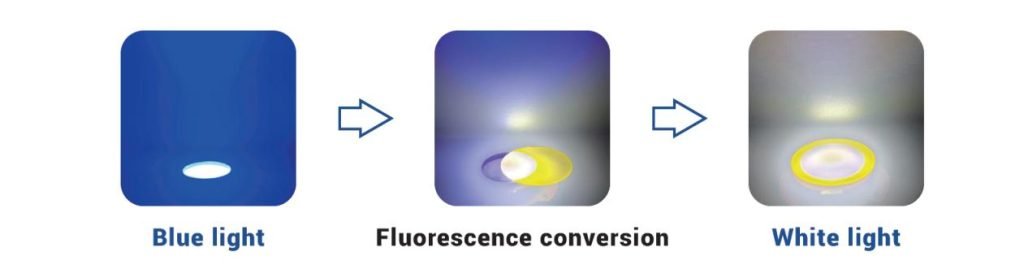
White light generation in solid-state devices relies heavily on phosphor-converted LED (pc-LED) architectures. A blue semiconductor die excites a down-conversion phosphor material, which emits yellow, green, or red wavelengths to produce white light.
Historically, manufacturers suspended these phosphor particles within an organic matrix, usually silicone or epoxy. This method, known as Phosphor in Silicone (PiS), works reliably at low to medium power densities. However, operating conditions become hostile once power levels scale upward.
High-power LED packages generate significant non-radiative heat via Stokes shift energy losses. This localized heat stays trapped near the emission site because silicone has very low thermal conductivity—typically between 0.1 and 0.2 W/m·K.
Under continuous high thermal load, the silicone matrix degrades. It yellows, cracks, and detaches from the chip face. This thermal degradation reduces light transmission, causes severe color shift, and accelerates device failure.
What Is Phosphor in Ceramic (PiC)?
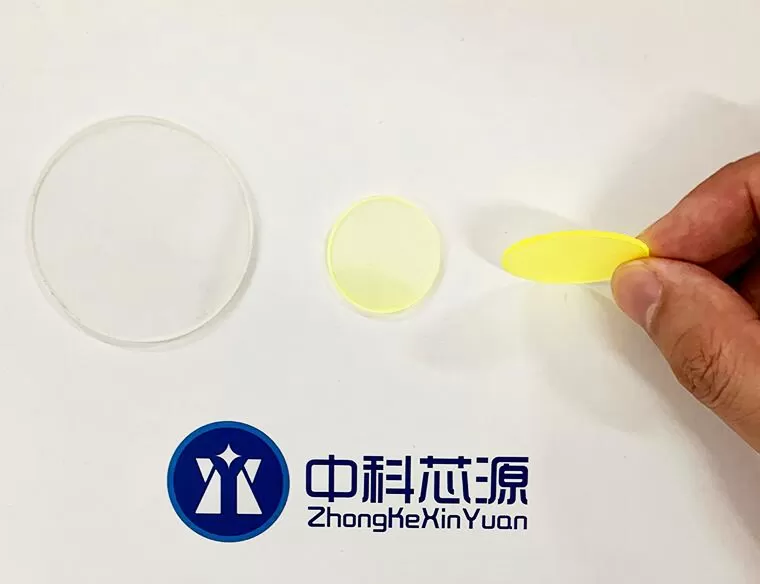
Phosphor in Ceramic represents a shift from organic composites to completely inorganic optical plates. It consists of luminescent phosphor grains, such as cerium-doped yttrium aluminum garnet (YAG:Ce), co-sintered directly with an inorganic oxide matrix like alumina (Al2O3) or formed into a single-phase polycrystalline ceramic.
The manufacturing process uses high-temperature, high-pressure sintering methods, including vacuum sintering, hot isostatic pressing (HIP), and spark plasma sintering (SPS). These processes eliminate microscopic voids, yielding a dense, rock-solid plate.
Because PiC contains zero silicone, resin, or organic binders, it is entirely free from organic aging mechanisms. The resulting material behaves as a thermally robust optical component that functions as both a wavelength converter and a heat spreader.
Core Advantages of Phosphor in Ceramic
1. Superior Thermal Conductivity
Thermal conductivity determines how rapidly an optical material dissipates localized heat away from the excitation hotspot. While conventional silicone matrices struggle at 0.2 W/m·K, ceramic phosphors deliver thermal conductivities ranging from 10 to over 30 W/m·K.
This hundred-fold improvement allows heat generated by Stokes shift losses to flow quickly into the package heat sink. By eliminating thermal choke points, the converter runs cooler, which extends the operational life of the entire module.
2. Resistance to Thermal Quenching
Thermal quenching occurs when elevated operating temperatures increase non-radiative energy dissipation inside the phosphor crystal lattice. As heat builds up, internal quantum efficiency drops, and the luminescent output falls dramatically.
In standard packages, this thermal collapse triggers a negative feedback loop: more heat leads to less light, which leads to further heat absorption. PiC materials exhibit exceptional thermal resistance, maintaining over 90% of their initial quantum efficiency at working temperatures exceeding 200°C.
3. High Flux Density and Radiation Hardness
Next-generation optical engines focus intense light into microscopic areas to achieve high center-beam candela. Laser-driven lighting (LD lighting) and micro-LED arrays generate optical power densities that burn silicone within seconds.
Phosphor in Ceramic absorbs continuous, highly concentrated blue light without carbonizing or blistering. This high radiation hardness makes ceramic plates the primary standard for laser-excited phosphor converters.
4. Color Consistency and Extended Lifetime
Silicone aging alters the mechanical position and refractive index surrounding phosphor grains, causing correlated color temperature (CCT) drift over time. Users see a visible shift from neutral white to cold blue or sickly yellow.
A ceramic converter provides fixed crystal boundaries and permanent mechanical rigidity. The optical path remains stable across tens of thousands of operating hours, ensuring reliable CCT maintenance and consistent chromaticity coordinates throughout product lifetimes.
Comparative Analysis: PiC vs. PiS vs. PiG
Optical engineers balance material properties against cost and manufacturing difficulty. The table below illustrates how Phosphor in Ceramic compares to Phosphor in Silicone and Phosphor in Glass (PiG).
| Performance Metric | Phosphor in Silicone (PiS) | Phosphor in Glass (PiG) | Phosphor in Ceramic (PiC) |
|---|---|---|---|
| Thermal Conductivity (W/m·K) | 0.1 – 0.2 | 0.8 – 1.5 | 10.0 – 35.0 |
| Max Operating Temperature (°C) | 120 – 150 | 200 – 300 | > 500 |
| Applicable Light Source | Low/Mid-Power LED | Mid/High-Power LED | Ultra-High Power LED & Laser Diodes |
| Resistance to Carbonization | Very Poor (Yellows/Burns) | Good | Immune (100% Inorganic) |
| Lumen Maintenance (L70) | Moderate | High | Exceptional (> 50,000 hrs) |
| Fabrication Complexity | Low (Dispensing/Molding) | Medium (Low-melting frit) | High (Sintering & Polishing) |
Phosphor in Glass serves as a functional intermediate material for mid-range power outputs. However, residual glass networks soften at elevated temperatures, and lower thermal conduction limits its use in high-flux laser systems.
To overcome these performance limits, the material synthesis team at CAS optimizes the grain size and boundary interfaces of pure ceramic matrices. This engineering produces void-free ceramics that maximize optical extraction while preserving structural integrity under severe heat cycles.
High-Impact Applications of Phosphor in Ceramic
Automotive LED and Laser Headlights
Modern vehicle designs feature narrower, sleeker headlight housings that leave little room for large cooling assemblies. Adaptive Driving Beam (ADB) systems and matrix LED headlamps demand immense luminous output from extremely compact source areas.
Automotive headlights running on ceramic converters deliver extended road projection distances without the risk of silicone breakdown under hot engine-compartment conditions.
- Laser High-Beams: PiC conversion plates convert focused blue laser beams into white light, delivering beam throws beyond 600 meters.
- Matrix Systems: High-density micro-LED arrays leverage ceramic converter plates to prevent inter-pixel color variations and maintain contrast.
Laser Projection and Display Engines
High-end cinema projectors, office installation displays, and home theater systems require compact optical sources that output tens of thousands of lumens. These optical engines focus banks of blue laser diodes onto a rotating or static phosphor target.
Ceramic plates allow projector manufacturers to eliminate large color wheels and lower overall maintenance costs, while maintaining crisp D65 white balance across prolonged operating schedules.
Stage, Studio, and Entertainment Lighting
Stage fixtures, spotlights, and broadcast studio lamps require maximum optical flux focused through complex optical lenses. Compact etendue is critical for precise beam shaping and uniform projection framing.
Because Phosphor in Ceramic handles intense excitation from tight emitter arrays, lighting designers can build smaller, brighter fixtures that draw less operating current while yielding excellent color rendering indices.
Industrial, Marine, and High-Mast Luminaires
Mining operations, sports arenas, shipping ports, and highway interchanges run continuous, high-wattage lighting systems under harsh weather conditions. Servicing these fixtures involves significant crane and maintenance labor expenses.
Using ceramic phosphor converters ensures reliable lumen maintenance over decades, reducing field failures and lowering long-term operating costs in heavy industrial environments.
Manufacturing Challenges and Engineering Trends
While Phosphor in Ceramic provides clear thermal and optical advantages, manufacturing it at scale presents real engineering hurdles. Achieving high quantum conversion requires balancing the optical transmittance and scattering properties inside the ceramic plate.
If the material contains too many micro-pores, internal backscattering increases, which sends blue excitation photons back to the source and hurts overall wall-plug efficiency. If the ceramic is completely transparent, excitation light bypasses the phosphor ions without converting, causing blue leakage.
Precise ceramic wafer grinding, lapping, and diamond dicing present additional cost challenges. Ceramic plates must be cut to tolerances measured in microns without chipping their brittle edges. Advanced laser scribing and specialized polishing processes are addressing these machining barriers.
Looking ahead, the market is moving toward multi-phase composite ceramics that blend red and green phosphors within a single substrate. These composite formulations give lighting engineers precise control over color rendering indices (CRI > 90) without sacrificing the high thermal conductivity of the host structure.
Frequently Asked Questions
Q1: What is the main difference between phosphor in ceramic and
traditional phosphor powder?
A1: Traditional phosphor consists of
loose microscopic powder particles that must be suspended in silicone or epoxy
resins to sit on an LED chip. Phosphor in ceramic is a solid, completely
inorganic plate created by sintering luminescent crystals into a dense body,
eliminating the need for polymers.
Q2: Why is laser-driven lighting (LD lighting) completely dependent
on phosphor in ceramic?
A2: Laser diodes concentrate immense optical
power onto an extremely small surface area. This high optical flux instantly
carbonizes, browns, or melts organic silicone binders. Phosphor in ceramic
withstands this intense photon bombardment and conducts heat away before the
converter sustains damage.
Q3: Does phosphor in ceramic suffer from thermal quenching like
phosphor in silicone?
A3: Ceramic phosphors experience far less
thermal quenching than silicone-encapsulated powders. Because their thermal
conductivity is up to 100 times higher, ceramic plates transfer heat away from
the excitation zone rapidly, maintaining their quantum efficiency even above
200°C.
Q4: How does phosphor in ceramic improve the optical system's
etendue?
A4: Optical etendue characterizes how spread out light is
in area and angle. By tolerating higher power densities, a ceramic converter
emits more lumens from a much smaller surface area. This small, intense emission
spot enables smaller secondary lenses and sharper beam-shaping control.
Q5: Is phosphor in ceramic economically viable for commercial LED
fixtures?
A5: While the initial purchase price of a ceramic optical
component exceeds that of silicone resin, it reduces the overall total cost of
ownership in high-output applications. Fixtures built with PiC require smaller
thermal heat sinks, fewer emitter packages, and fewer field replacements over
their service life.
Partner with CAS for High-Power Optical Engineering
Phosphor in Ceramic is resetting thermal and luminance limits across the solid-state lighting sector. By replacing heat-sensitive organic binders with rugged inorganic crystal matrices, PiC allows optical engineers to create brighter, more compact, and more reliable illumination products.
CAS supplies advanced Phosphor in Ceramic components engineered to meet exact chromaticity, flux density, and thermal tolerance specifications. Whether you are improving an existing LED platform or designing a cutting-edge laser-driven illumination engine, our materials team is ready to support your program.
Submit your design specifications or request an engineering consultation with CAS today to discuss custom ceramic compositions, target geometries, and prototype production.