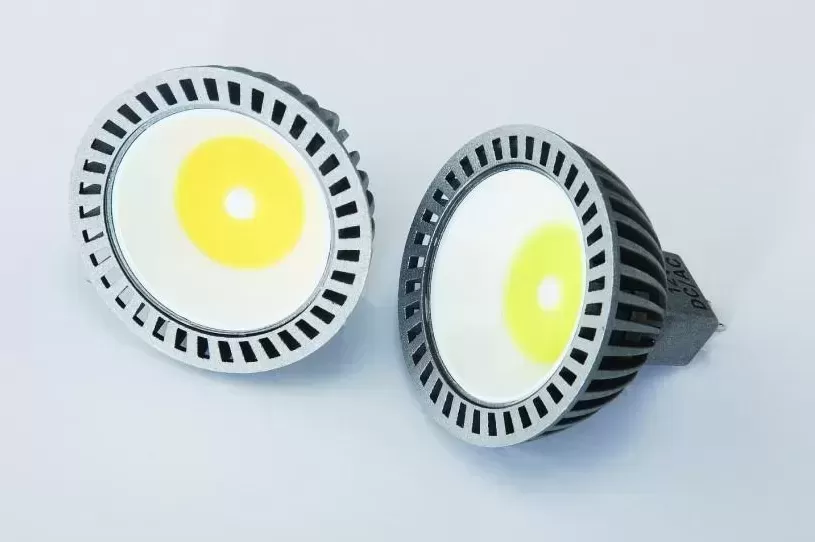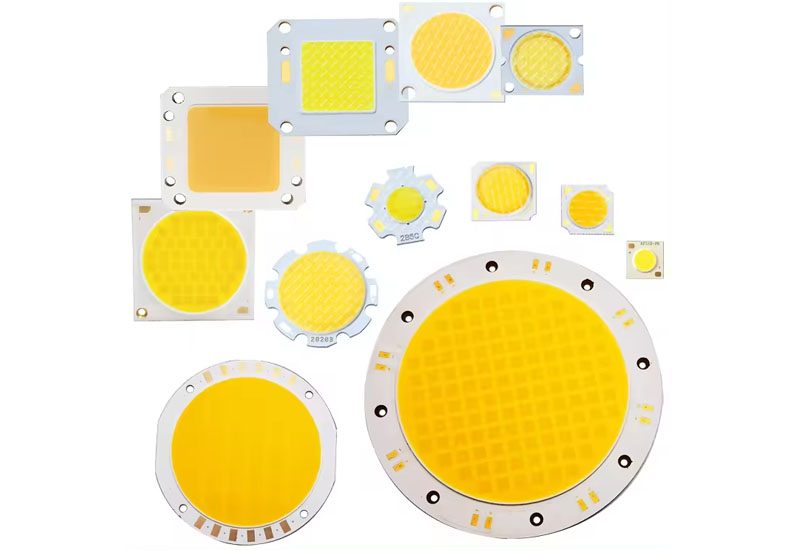
Solid-state lighting architectures operating at extreme power densities demand precise engineering. As luminaire manufacturers replace legacy metal halide and high-pressure sodium lamps in high-bay, stadium, and maritime applications, single-point high-output emitters have become standard. A 500w Led Cob represents a concentrated thermal and electrical package, delivering anywhere from 50,000 to over 80,000 lumens from a surface area typically smaller than a standard coaster. Successfully integrating such a module requires a multi-disciplinary approach covering advanced materials science, micro-optics, and power electronics.
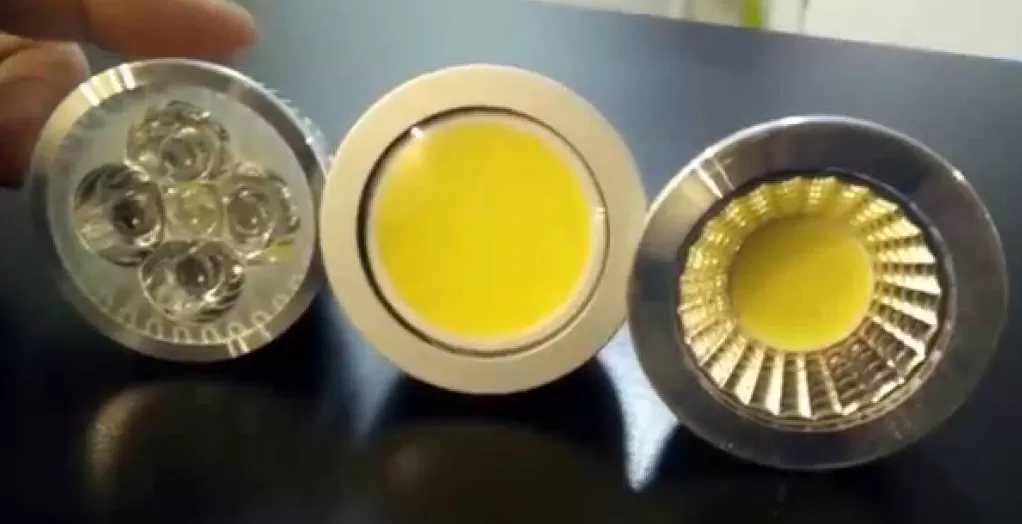
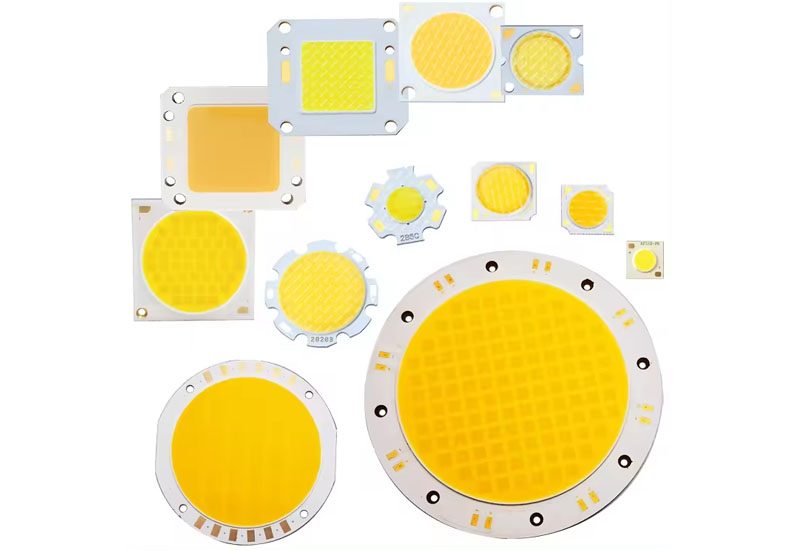
High-wattage Chip-on-Board (COB) packages provide distinct mechanical and photometric advantages over discrete SMD arrays. By packing hundreds of micro-scale LED dies onto a single direct-bonded substrate under a continuous phosphor layer, these arrays generate a uniform, high-intensity light source that functions closely to an optical point source. This density simplifies secondary optical design while introducing severe engineering challenges related to junction temperature management, current sharing across dies, and phosphor longevity under sustained radiant flux.
Thermal Management Architectures for High-Density Arrays
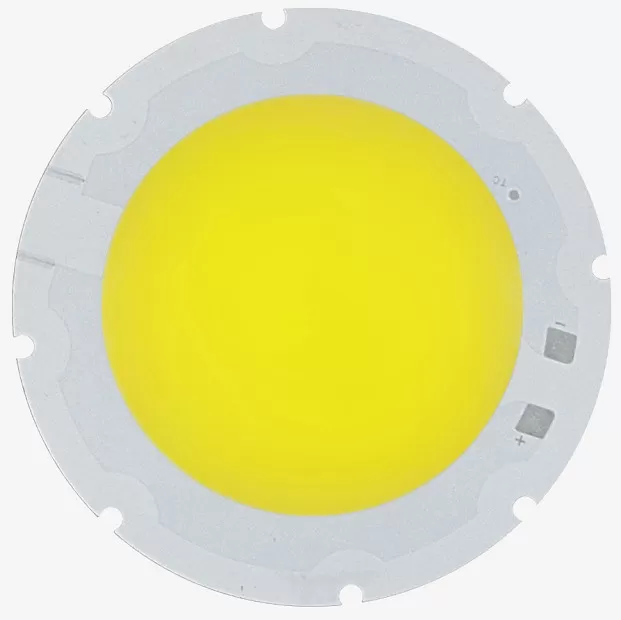
Heat dissipation represents the primary performance limiter for high-power packaging. A 500w Led Cob generates hundreds of thermal watts within an active area often spanning just 28mm to 45mm in diameter. Operating at these densities requires minimum thermal resistance across every layer of the assembly stack.
The internal structure of the module relies on advanced substrate materials to conduct heat away from the semiconductor junctions:
Aluminum Oxide (Al2O3) vs. Aluminum Nitride (AlN): Standard low-power COBs frequently use aluminum oxide substrates with thermal conductivities around 20 to 30 W/mK. For 500-watt loads, Aluminum Nitride ceramic substrates are standard, providing thermal conductivity ratings between 170 and 200 W/mK.
Direct Plated Copper (DPC): DPC technology enables thin, highly conductive copper trace deposition directly onto ceramic surfaces. This eliminates the thick, thermally resistive dielectric layers found in standard metal core PCBs (MCPCB), dropping internal thermal resistance significantly.
Die-Attach Methods: Traditional conductive silver epoxy creates a thermal barrier at high currents. High-output designs utilize eutectic die bonding or silver sintering, reducing junction-to-substrate resistance ($R_{th, j-s}$) to below 0.15 °C/W.
Managing heat outside the module demands heat sink configurations capable of dissipating hundreds of watts while maintaining a junction temperature ($T_j$) well below maximum limits (typically 125°C to 150°C). Passive extruded aluminum fin structures are generally too massive for compact luminaires at this power level. Instead, system designers use phase-change solutions such as nickel-plated copper vapor chambers or multi-loop sintered heat pipe assemblies embedded directly into forged aluminum cold plates.
Thermal interface materials (TIM) require strict torque specifications during mechanical fastening. Using a high-grade phase-change material or non-curing silicone-free thermal grease with a thermal conductivity above 6.0 W/mK ensures that micro-voids between the COB substrate and the heat sink base are eliminated without introducing excessive bond line thickness.
Optical Engineering and Lumen Density Precision
The luminous surface (LES) diameter dictates how light behaves when matched with secondary optics. An optical designer working with a 500w Led Cob must balance the total light output against the physical size of the emission window.
A smaller LES generates higher center-beam candlepower (CBCP), which proves advantageous for narrow-beam applications such as high-mast port towers, architectural searchlights, and long-throw sports arena floodlights. Conversely, a larger LES reduces thermal density per square millimeter, simplifying cooling at the expense of optical punch.
Secondary optical coupling requires specific material selections to withstand intense radiant energy:
Borosilicate Glass Lenses: Polycarbonate (PC) and standard PMMA acrylics risk yellowing or micro-cracking when placed within close proximity to a 500W source emitting high radiant flux and localized heat. Optical-grade borosilicate glass offers high transmission rates (above 94%) without thermal degradation over long operational lifespans.
Optical Silicone Optics: Injection-molded optical silicones provide exceptional thermal stability and UV resistance, allowing direct contact or near-field placement relative to the phosphor plane.
Precision Aluminum Reflectors: Faceted and vacuum-metallized aluminum reflectors, treated with multi-layer dielectric coatings, provide high reflectivity (often >98%) and help eliminate color-over-angle artifacts that can occur near the periphery of the beam pattern.
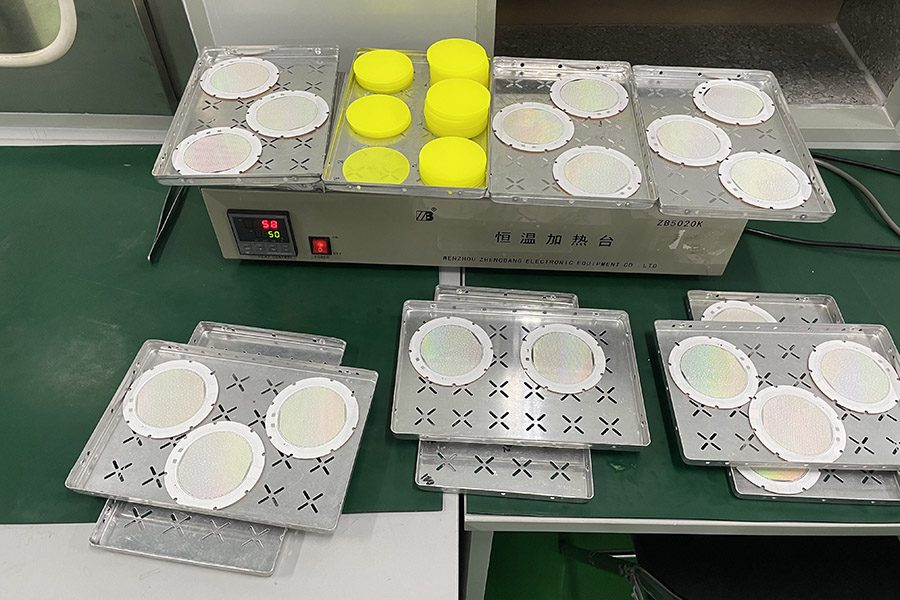
Color consistency across the beam angle is governed by phosphor deposition consistency. When integrating modules developed by specialized manufacturers like CAS, systematic phosphor sedimentation and automated conformal coating minimize chromaticity shifts, ensuring that the light maintains a tight 3-step or 2-step MacAdam ellipse profile from the center beam to the field edge.
Electrical Topologies and Driver Compatibility
Operating a high-power COB requires stable current regulation. Variations in forward voltage ($V_f$) caused by junction temperature fluctuations require robust constant current driver designs equipped with broad voltage operating windows.
A standard 500w Led Cob is typically wired in a multi-channel matrix combining dozens of parallel strings of series-connected dies. Depending on the packaging architecture, nominal forward voltages generally fall into specific ranges:
High-Voltage, Low-Current Configurations: Typical parameters range from 140V to 180V with forward currents around 2.8A to 3.5A. These configurations minimize resistive $I^2R$ power losses across luminaire wiring harnesses and reduce copper trace cross-section requirements within the fixture.
Medium-Voltage Configurations: Operating around 48V to 54V at 9A to 11A. These are common where low-voltage safety directives (SELV) govern system design, though they necessitate heavier wiring and tighter tolerance on connection contact resistance.
Current hogging represents a failure mode in poorly designed die matrices. If forward voltages among parallel die strings are uneven, current naturally routes through the path of least resistance, causing localized overheating, rapid phosphor burning, and premature module failure. Quality manufacturing requires precise die matching, automated binning, and integrated Zener transient suppression diodes within the substrate layout.
Driver pairing must also address low-frequency current ripple. In broadcast sports lighting or high-speed manufacturing environments, current ripple must remain below 1% to prevent optical flicker during slow-motion camera capture. Industrial drivers should support intelligent dimming interfaces—such as DALI-2, 0-10V isolated, or DMX-RDM—with smooth linear and logarithmic dimming down to 1% without introducing chromaticity shifts.
Demanding Application Environments
The high lumen-to-size ratio of the 500w Led Cob makes it a core component for fixtures intended for severe mechanical, environmental, and duty-cycle stresses.
High-Mast Industrial Infrastructure
Logistics terminals, marine ports, and railway switchyards demand fixtures that operate continuously at ambient temperatures reaching up to 50°C. In these environments, luminaire weight and wind-load surface area must be kept minimal to prevent mechanical stress on existing structural poles. A single COB luminaire provides the narrow-beam projection power previously requiring massive multiple-SMD panels, cutting luminaire surface area and drag coefficients substantially.
High-Speed Sports Arenas and Field Broadcasts
Modern stadiums require high vertical illuminance, exceptional color rendering (CRI > 90, TLCI > 95), and continuous thermal reliability. Using a high-output module ensures precise beam control via narrow secondary optics, directing light directly onto playing surfaces without causing light trespass or high-angle glare for spectators and broadcast equipment.
Heavy-Duty Manufacturing and Foundries
Foundries, steel mills, and chemical processing facilities expose lighting hardware to ambient particulates, caustic vapors, and heavy vibration. Using an ultra-high-output emitter allows fixtures to be mounted at heights exceeding 20 meters, clear of overhead cranes and high-temperature machinery, while maintaining targeted lux levels on the operational floor.
Durability, Degradation, and Quality Metrics
Assessing the long-term reliability of a 500w Led Cob goes beyond initial lumen output and nominal wattage ratings. Continuous high-temperature exposure creates stress points that must be evaluated through standard test methodologies.
The primary degradation mechanisms include:
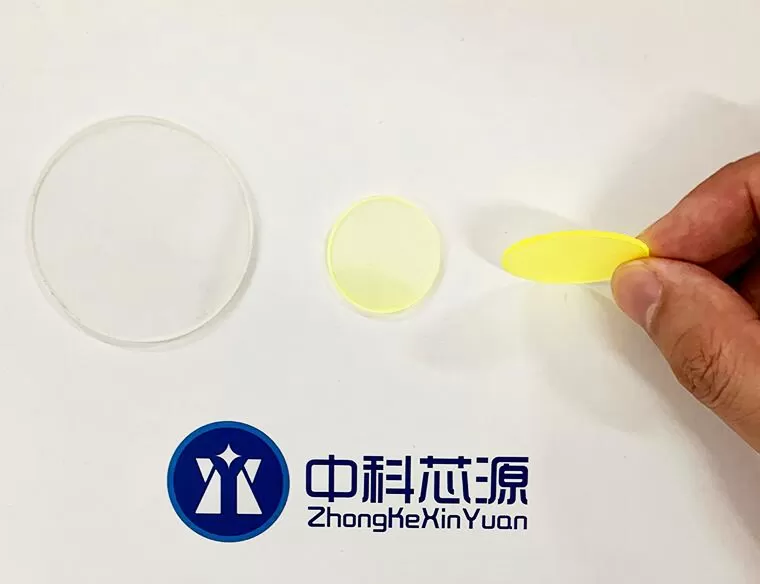
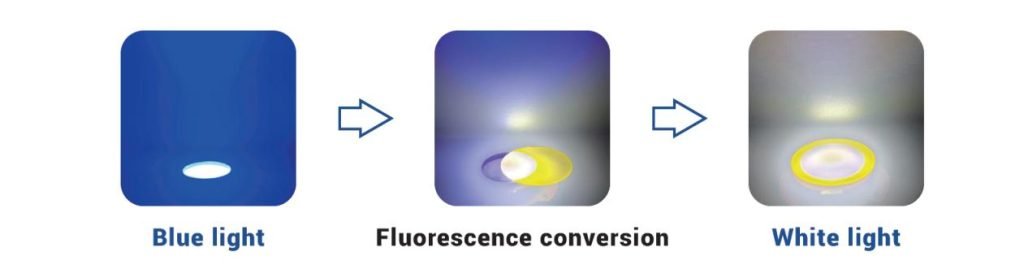
Phosphor Matrix Carbonization: Silicone binders holding the rare-earth phosphors can degrade under simultaneous high temperatures and intense short-wavelength blue photon flux. Premium modules use advanced heat-resistant silicones or glass-phosphor plates to maintain spectral stability over tens of thousands of hours.
Interconnect Fatigue: Repetitive thermal cycling from daily on/off duty causes expansion and contraction stresses across the substrate, bond wires, and solder pads. Sintered assemblies mitigate these micro-fracture formations.
Lumen Maintenance Modeling: Fixture builders should rely on verified IES LM-80 test data coupled with TM-21 extrapolations. High-grade modules deliver verified $L_{90}B_{10}$ lifespans exceeding 50,000 hours at casing temperatures ($T_c$) of 85°C.
When specifying these arrays, engineering teams should evaluate the quality verification processes utilized by the supplier. High-reliability manufacturing processes from suppliers such as CAS ensure that every sub-mount undergoes automated optical inspection, optical spectrum validation, and high-voltage isolation breakdown tests prior to distribution.
Assembly and Mounting Requirements
The practical integration of high-wattage COB emitters on the factory floor directly influences field reliability. Automated assembly operations must follow strict protocols regarding mechanical tolerances and connection methodologies.
Direct soldering of input wires to the contact pads requires temperature-controlled soldering stations to avoid delaminating the copper traces from the ceramic base. Alternatively, solderless COB holders with integrated spring contacts and secondary optic locating pins are widely preferred in volume production. These holders ensure uniform clamping force across the substrate surface, which maintains a stable bond line thickness for the thermal interface material without causing mechanical stress or cracking in the ceramic base.
Frequently Asked Questions
What is the typical operating life of a 500w Led Cob under standard industrial conditions?
When supported by a thermal management system that keeps casing temperatures ($T_c$) below 85°C, a high-quality unit typically achieves an $L_{70}$ operational lifespan of 60,000 to 100,000 hours. The lifespan is directly tied to the thermal resistance of the fixture and driver current stability.
Can a single 500W COB replace a 1000W Metal Halide lamp directly?
Yes. A 1000W metal halide fixture produces roughly 80,000 to 100,000 initial raw lumens, but system efficiency drops significantly due to ballast losses and omnidirectional light output trapped inside the reflector. A directional 500W solid-state module delivering 65,000 to 75,000 lumens with targeted optics easily matches or exceeds the usable lux levels of legacy 1000W fixtures while cutting electrical consumption by roughly 50%.
How does LES size impact secondary optic design?
A smaller Light Emitting Surface (LES) allows secondary optical lenses and reflectors to focus light into tighter beam angles with higher center-beam intensity. A larger LES creates a broader beam spread and requires substantially larger optics to achieve narrow distribution angles.
Why is Aluminum Nitride preferred over Aluminum Oxide for high-wattage arrays?
Aluminum Nitride (AlN) has a thermal conductivity between 170 and 200 W/mK, compared to Aluminum Oxide (Al2O3), which provides roughly 20 to 30 W/mK. For high-density heat loads, AlN prevents heat concentration underneath the individual dies, dropping junction temperatures and prolonging component life.
What type of driver current ripple is acceptable for sports broadcast lighting?
For standard lighting, a current ripple of 5% to 10% is acceptable. For ultra-high-definition and slow-motion broadcast environments, the LED driver must supply smooth DC power with a total ripple below 1% to eliminate visible banding and high-speed flicker.
Engineering Support and Custom Integration
Developing industrial lighting equipment around a 500w Led Cob demands deep system-level coordination across thermal sinks, driver electronics, and precision optics. Sourcing high-grade solid-state emitters backed by verified LM-80 datasets and precise binning structures is the foundation of reliable fixture production.
The technical engineering team at CAS provides specialized consultation, custom module substrate layouts, and photometric evaluation for OEM fixture manufacturers globally. Contact our industrial illumination specialists to discuss your application requirements, obtain detailed spec sheets, or request sample units for your upcoming product validation cycle.