High-power solid-state lighting has transitioned from standard municipal illumination to highly demanding industrial, automotive, and projection systems. As luminous flux requirements increase, traditional optical packaging materials face physical limitations. Silicone-based encapsulants and organic binders degrade rapidly under high-density blue light excitation and elevated operational temperatures. To address these limitations, material scientists have developed inorganic color converters. Among these developments, Woosuk phosphor ceramic has emerged as a reliable solution for high-brightness and laser-diode illumination systems, distributed and supported globally by CAS.
This material-science analysis examines how this inorganic ceramic converter resolves the thermal and optical bottlenecks inherent in traditional packaging, its operational behavior under high power density, and the integration pathways for industrial lighting manufacturers.
The Mechanics of Thermal Quenching in Solid-State Lighting
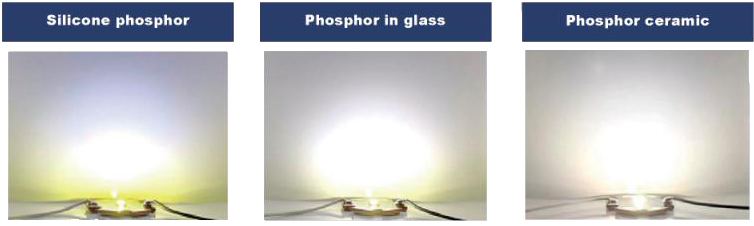
The primary challenge in high-power light-emitting diode (LED) and laser diode (LD) design is the management of heat generated within the color converter. When a blue pump light excites a phosphor, a portion of the absorbed energy is lost as heat due to non-radiative relaxation, a phenomenon known as the Stokes shift. In conventional configurations, phosphor powder is suspended in a silicone or polymer matrix.
Silicone possesses a thermal conductivity of less than 0.3 W/m·K. Because of this poor thermal dissipation, the heat generated by the Stokes shift remains trapped within the phosphor particles, causing the local temperature to rise rapidly. At elevated temperatures, the probability of non-radiative transitions increases, leading to thermal quenching. This results in a sharp drop in luminous efficacy, shifts in the correlated color temperature (CCT), and eventual yellowing or cracking of the organic binder. Once the binder degrades, the optical path is permanently compromised, leading to premature component failure.
By replacing the organic silicone matrix with a fully inorganic polycrystalline ceramic structure, this thermal barrier is eliminated. Woosuk phosphor ceramic provides a self-supporting, highly conductive pathway for heat dissipation. The absence of organic binders prevents yellowing, allowing the converter to withstand high optical power densities without degradation.
Structural Composition and Optical Properties of Woosuk Phosphor Ceramic
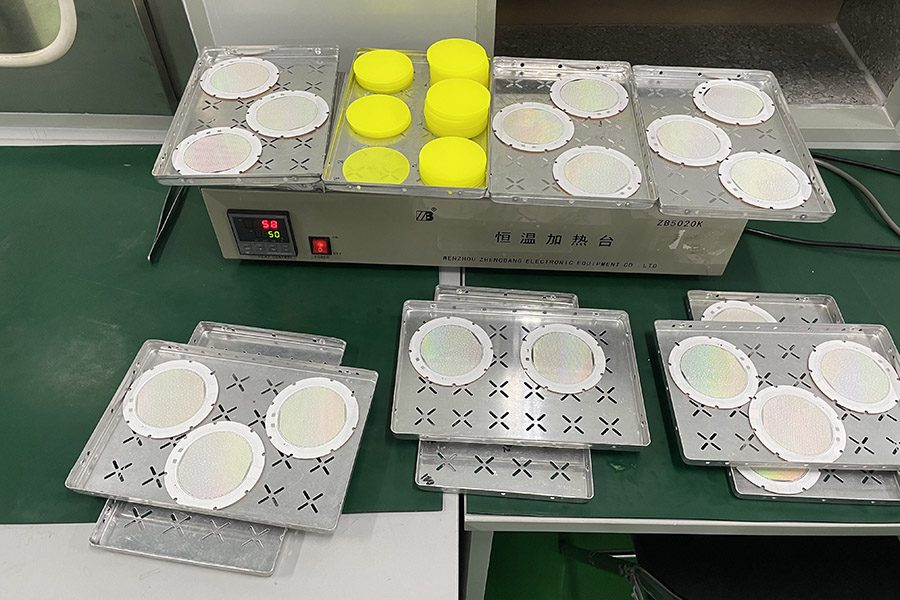
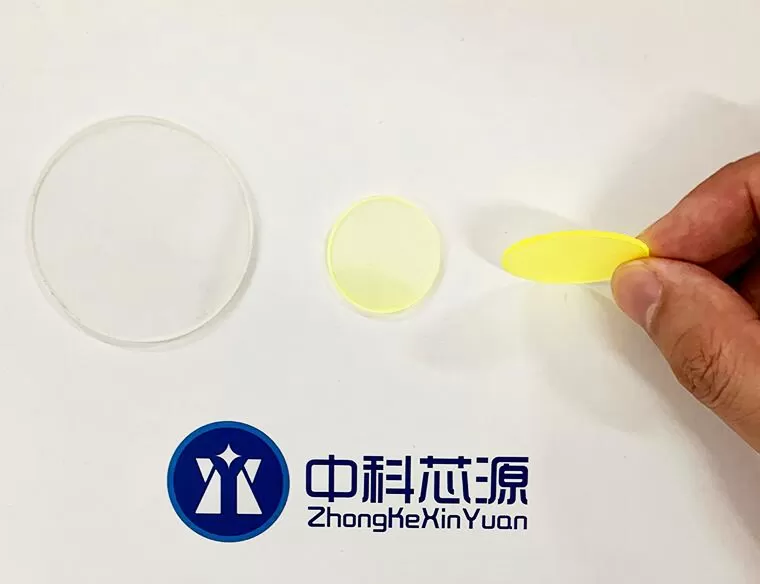
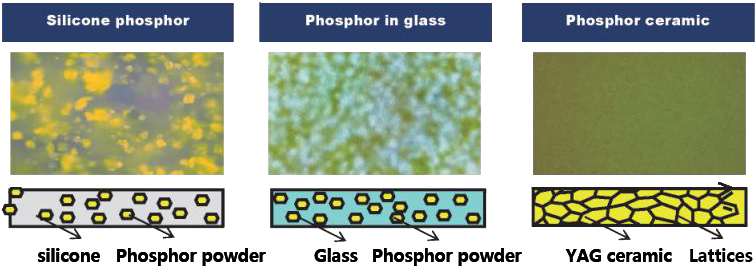
The performance of Woosuk phosphor ceramic lies in its microstructural composition. Unlike single crystals or glass powders, this material is produced through a high-temperature pressure-sintering process that fuses phosphor particles, such as Cerium-doped Yttrium Aluminum Garnet (YAG:Ce) or Lutetium Aluminum Garnet (LuAG:Ce), into a dense, pore-controlled polycrystalline ceramic plate. CAS provides these components with precise thickness and dopant concentration control to meet specific spectral requirements.
The sintered ceramic matrix features several specific attributes:
Thermal Conductivity: Achieving values between 8 to 15 W/m·K, which is more than thirty times higher than traditional silicone encapsulants. This rapid heat transfer keeps the junction temperature of the phosphor well below the thermal quenching threshold.
Controlled Porosity: Micro-pores within the ceramic structure act as light-scattering centers. By adjusting the size and distribution of these pores, manufacturers can control the scattering coefficient, balancing optical transmittance and color rendering without requiring external scattering agents.
High Internal Quantum Efficiency: The high purity of the starting powders and refined sintering profiles preserve the crystalline structure of the phosphor host lattice, maintaining high internal quantum efficiency even at operational temperatures exceeding 150°C.
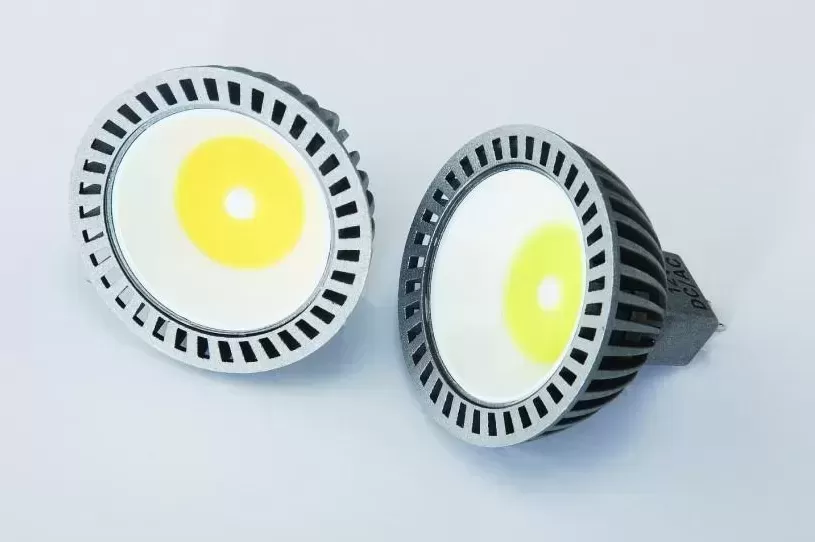
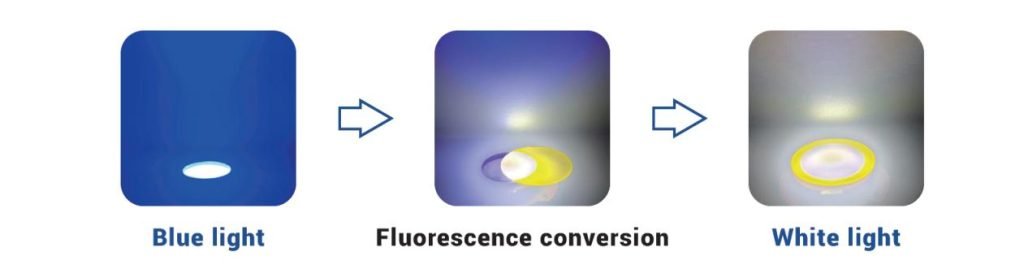
This combination of thermal resilience and optical control makes the material highly suitable for Laser-Activated Remote Phosphor (LARP) applications, where blue laser beams are focused onto a small area to generate high-intensity white light.
Comparative Analysis: Materials for High-Flux Color Conversion
To understand the position of Woosuk phosphor ceramic in the market, it is helpful to compare the primary types of color conversion materials currently available for high-power packaging designs.
| Property | Phosphor-in-Silicone (PiS) | Phosphor-in-Glass (PiG) | Woosuk Phosphor Ceramic (CAS) |
|---|---|---|---|
| Thermal Conductivity (W/m·K) | 0.1 – 0.3 | 1.0 – 1.5 | 8.0 – 15.0 |
| Max. Operational Temp (°C) | < 150°C | < 250°C | > 350°C |
| Optical Stability under Blue Laser | Poor (Rapid degradation) | Moderate | Excellent (No degradation) |
| Color Uniformity (Angular) | Variable | Moderate | High (Excellent scattering) |
| Mechanical Strength | Flexible/Soft | Brittle | High (Polycrystalline) |
While Phosphor-in-Glass (PiG) offers an improvement over silicone, the glass matrix still limits overall thermal dissipation due to its low thermal conductivity. For applications operating at power densities exceeding 10 W/mm², the superior thermal performance of a true polycrystalline ceramic is necessary to prevent localized thermal breakdown.
Primary Applications and Engineering Solutions
The transition to inorganic ceramics has enabled new configurations in several demanding illumination sectors. CAS closely collaborates with engineering teams to integrate these converters into diverse operational setups.
Automotive Solid-State Headlamps
Modern automotive headlamps require compact, high-intensity light sources to enable adaptive driving beams and long-range laser high beams. Standard LEDs cannot produce the required luminance within the spatial limitations of aerodynamic headlight housings. By utilizing a blue laser diode focused onto a reflective Woosuk phosphor ceramic plate, automotive designers can generate a highly concentrated white light source. This setup achieves a beam distance of over 600 meters while keeping the optical module compact.
High-Lumen Industrial Projection Systems
Digital cinema projectors and large-venue display systems require consistent, high-intensity color output over thousands of operational hours. Organic color wheels degrade under the heat generated by high-power blue laser light sources. Incorporating ceramic phosphors into static or rotating converter wheels ensures stable color output, minimizes thermal drift, and prevents color shifts during long projection cycles.
Outdoor Searchlights and Maritime Navigation
Searchlights, marine beacons, and helicopter illumination systems operate in harsh environments where thermal shock, vibration, and moisture are constant challenges. The mechanical durability of the polycrystalline ceramic structure ensures that the optical properties remain unchanged despite rapid temperature fluctuations and physical impacts.
Integration and Structural Assembly Considerations
Implementing a ceramic color converter requires careful consideration of the physical and mechanical mounting interfaces. Because the ceramic plate is a separate component, it must be bonded to a heat-dissipating substrate to utilize its high thermal conductivity.
Manufacturers typically employ two mounting methods:
In reflective mode configurations, the ceramic plate is bonded directly to a highly reflective metal substrate, such as gold- or silver-plated copper, using a thermal interface material. The blue laser excites the ceramic from the front, and the converted yellow light, along with the scattered blue light, is reflected forward. This design is highly effective for heat dissipation because the backside of the ceramic is in direct contact with a metal heatsink.
In transmissive mode configurations, the blue light passes through the ceramic plate. The plate must be mounted at its edges to a metal holder or bonded to a transparent substrate like sapphire. While transmissive systems simplify the optical path, thermal management is more demanding. The thickness of the ceramic plate must be calibrated to balance blue light transmission and yellow light conversion, while ensuring sufficient heat dissipation from the edges of the plate.
CAS provides design support and customized dicing services to ensure that the dimensions and surface finishes of the ceramic plates match the specific thermal and optical requirements of both configurations.
Optimizing Spectral Output and Color Consistency
Achieving a specific target color coordinate, such as cool white for automotive use or neutral white for architectural lighting, requires precise control over the ceramic thickness and doping level. A ceramic plate that is too thin will allow excessive blue light to pass through, resulting in a high CCT and a bluish hue. Conversely, a plate that is too thick will absorb too much blue light, leading to a yellow-green output with reduced overall efficacy.
Through advanced manufacturing and sintering controls, Woosuk phosphor ceramic plates are produced with tight dimensional tolerances, often within +/- 5 micrometers. This precision ensures consistent color uniformity across production batches, helping B2B manufacturers maintain strict color binning standards without high rejection rates during final assembly testing.
Frequently Asked Questions
Q1: What is the main structural difference between Woosuk phosphor ceramic and standard Phosphor-in-Glass (PiG)?
A1: Woosuk phosphor ceramic is a fully inorganic polycrystalline material produced by sintering phosphor crystals together at high temperatures and pressures, achieving a pure ceramic structure. In contrast, Phosphor-in-Glass consists of phosphor powder dispersed within a glass frit matrix. The pure ceramic structure provides significantly higher thermal conductivity (8-15 W/m·K) compared to the glass matrix of PiG (typically 1-1.5 W/m·K), allowing it to handle much higher optical power densities.
Q2: Can these ceramic converters be customized for specific color rendering indexes (CRI) and color temperatures?
A2: Yes. By adjusting the composition of the phosphor hosts—such as combining green-emitting LuAG:Ce with yellow-emitting YAG:Ce—and modifying the thickness of the plate, the spectral output can be adjusted. CAS works with clients to customize these parameters to achieve specific CCT and CRI targets for different application requirements.
Q3: How does the material behave under continuous laser exposure over time?
A3: Because the material is completely inorganic and contains no organic binders or resins, it does not suffer from photo-thermal degradation. Under continuous blue laser exposure within recommended power densities, it exhibits negligible thermal quenching and no optical degradation, ensuring stable performance over tens of thousands of operating hours.
Q4: What bonding methods are recommended to attach the ceramic plate to a heatsink?
A4: For high-power reflective configurations, thin-film metallization (such as sputtering gold or titanium/platinum/gold) is applied to the backside of the ceramic plate. This allows the plate to be soldered directly onto copper or aluminum nitride (AlN) submounts using gold-tin (AuSn) or indium alloys, minimizing thermal interface resistance. High-performance thermal adhesives can also be used for lower-power applications.
Q5: What are the standard dimensions and thicknesses available for engineering evaluation?
A5: The plates are typically produced in wafer forms and can be diced into custom square or rectangular sizes, ranging from 1mm x 1mm to larger custom configurations. Standard thicknesses range from 100 micrometers to 500 micrometers, depending on whether the system uses a transmissive or reflective optical design.
Inquiry and Support
Selecting the correct material thickness, composition, and mounting configuration is essential to achieving optimal performance in high-power lighting systems. CAS provides complete engineering support, raw material supply, and custom dicing services for Woosuk phosphor ceramic products. For detailed product specifications, custom dimensions, or to discuss your specific optical application with an engineer, please contact the CAS team to submit an inquiry.