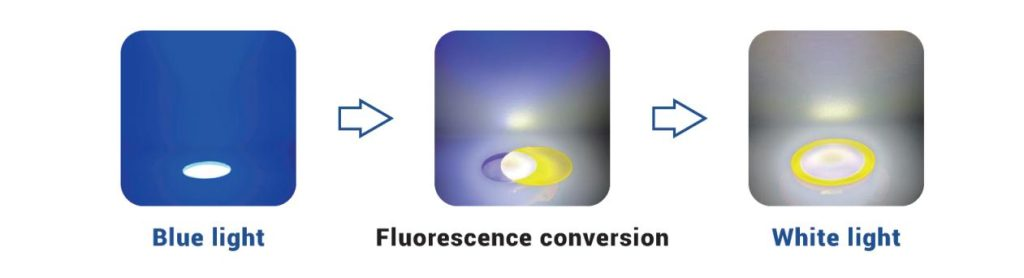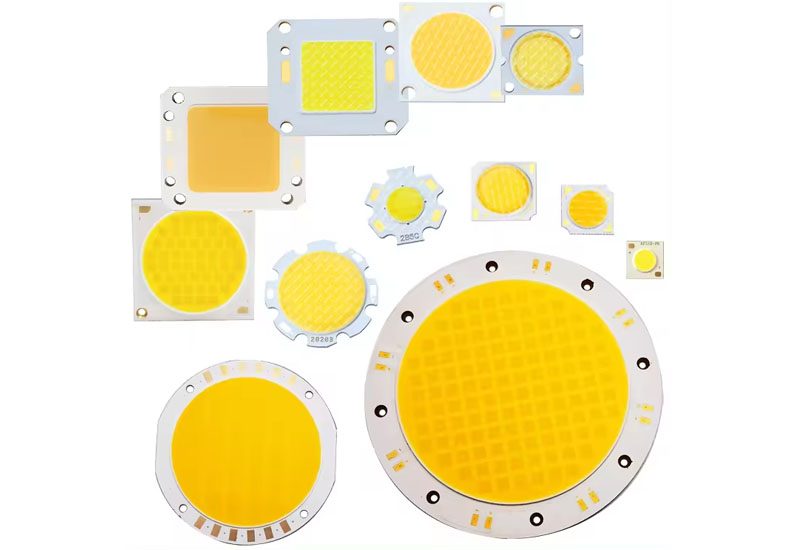
At CAS, our engineering team regularly assists optical designers who encounter severe output degradation when testing traditional wavelength converters under laser excitation. If your system exceeds power densities of a few watts per square millimeter, standard organic-matrix conversion materials will fail quickly. Selecting the right color converter decides whether your product survives thousands of hours or suffers thermal runaway within minutes.
This technical comparison breaks down the physical properties, operational limits, and economic considerations of phosphor ceramic plates versus phosphor films. If you are currently qualifying materials for high-flux optical engines, contact our application engineers to request evaluation samples or discuss your thermal requirements.
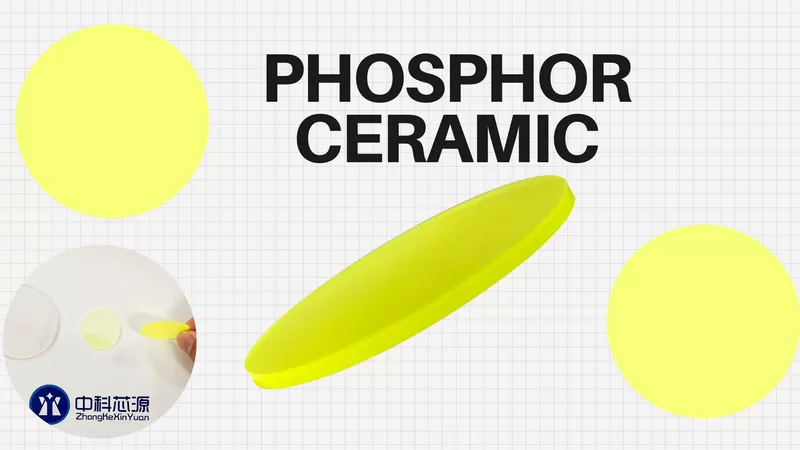
The Basics: What are Phosphor Ceramics and Phosphor Films?
Before analyzing thermal boundaries and optical efficiency, we must examine how manufacturers build these two materials. Their microstructural makeup dictates how they handle heat, scatter light, and resist laser damage.
Phosphor Ceramic: All-Inorganic Structural Integrity
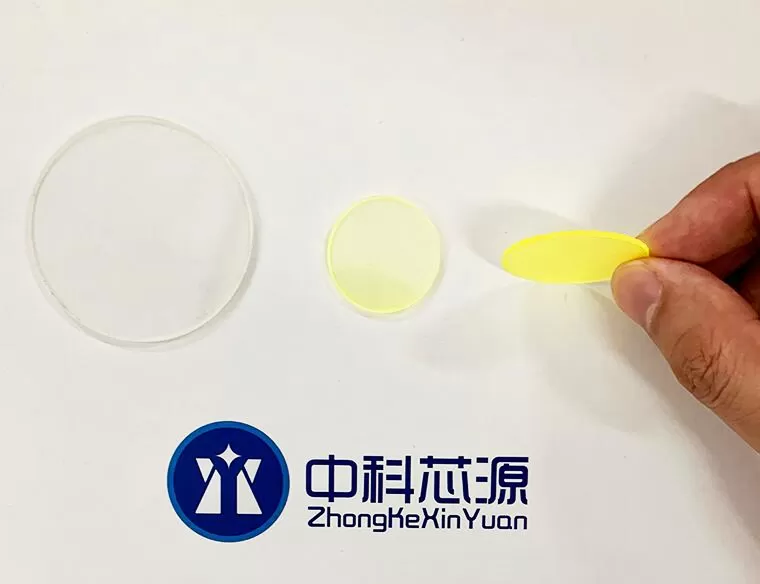
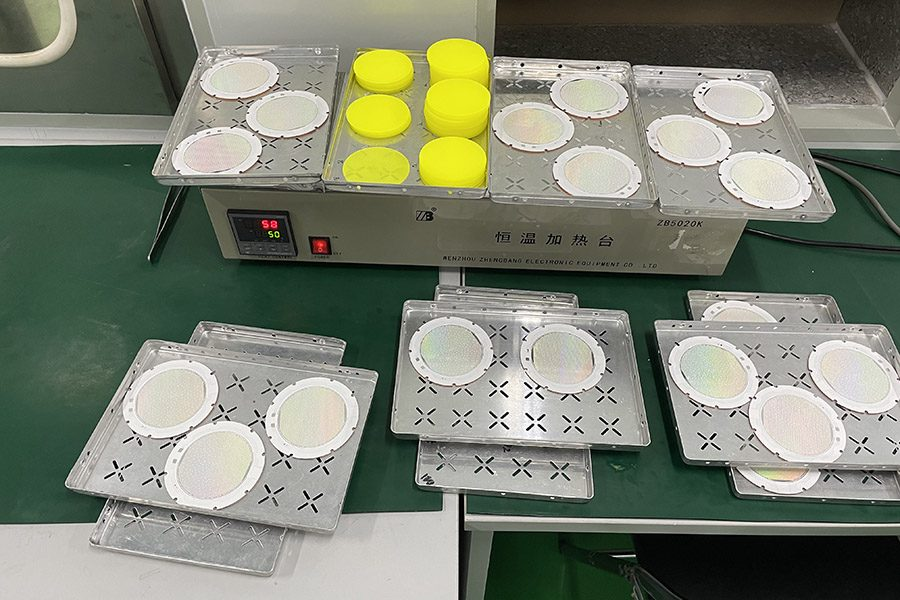
A phosphor ceramic is a solid, fully inorganic luminescent component. Engineers produce it by sintering ceramic-grade phosphor powders (such as cerium-doped yttrium aluminum garnet, or Ce:YAG) at extreme temperatures, typically between 1600°C and 1800°C, under vacuum or controlled atmospheres.
This sintering process drives out porosity and fuses individual grains into a dense polycrystalline plate. The finished converter contains zero organic binders, glues, or silicone resins. The luminescent material itself forms the structural matrix. Because it is pure ceramic, it exhibits mechanical hardness, chemical stability, and exceptional thermal tolerance.
Phosphor Film: Phosphor Grains in a Polymer Matrix
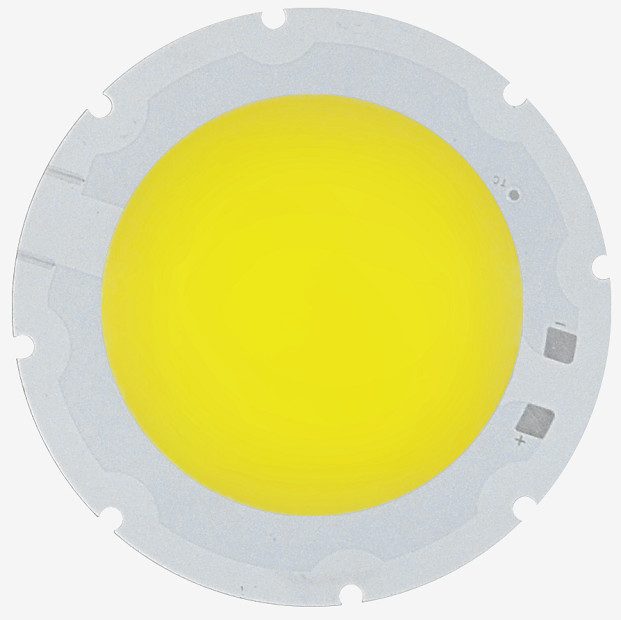
A phosphor film relies on a composite structure. Manufacturers disperse inorganic phosphor powders into a carrier medium, usually optical-grade silicone, epoxy, or a flexible polymer substrate. They then blade-coat, cast, or screen-print this slurry onto a carrier film or glass plate to a specific thickness.
Phosphor films offer flexibility and straightforward thickness control. They dominate consumer displays, backlighting units, and mid-power LED packages. However, the presence of the polymer matrix creates a fundamental physical ceiling when exposed to extreme thermal loads and high-intensity optical radiation.
Head-to-Head: Key Performance in High-Power Environments
When pump power density increases, the physical behavior of conversion materials changes drastically. The following sections explore how both materials hold up under severe stress.
Thermal Conductivity and Heat Dissipation
Thermal management is the most decisive factor in high-power converters. When a blue laser pumps yellow-emitting phosphor, the Stokes shift inevitably generates heat inside the converter plate. If that heat cannot escape rapidly to a heatsink, the converter temperature skyrockets.
A high-quality phosphor ceramic provides bulk thermal conductivity values typically between 9 and 14 W/m·K. Some composite ceramic variants engineered with aluminum oxide (Al2O3) phases reach up to 25 to 30 W/m·K. Because phonons travel efficiently through continuous crystal lattices, heat moves swiftly from the optical excitation zone to the copper mount.
In contrast, standard phosphor films offer a thermal conductivity well below 0.3 W/m·K, rarely exceeding 0.8 W/m·K even with thermal additives. The silicone or polymer matrix acts as a thermal insulator. Trapped heat builds up inside the film, creating localized hot spots that rapidly accelerate degradation.
Thermal Quenching and Luminous Saturation Threshold
Thermal quenching occurs when elevated internal temperatures open non-radiative relaxation pathways within the activator ions (such as Ce3+). Instead of emitting visible photons, excited electrons transfer energy as heat back into the host lattice. This lowers luminous output and drives temperatures even higher.
Phosphor ceramics maintain high internal quantum efficiency at elevated operating temperatures. Many dense YAG ceramics retain over 85% to 90% of their initial luminescence at 200°C. Their high saturation threshold allows them to accept optical power densities ranging from 20 W/mm² to over 60 W/mm² without quenching, provided adequate cooling interfaces exist.
Phosphor films reach thermal quenching at much lower excitation thresholds. Most silicone-based films experience significant output drop-off once local temperatures cross 120°C to 150°C. Beyond 2 to 5 W/mm², the luminous output saturates, meaning additional pump laser power produces only extra heat rather than more visible lumens.
For more details on non-radiative relaxation and temperature limits in solid-state converters, refer to research documented by the U.S. Department of Energy Solid-State Lighting Program.
Reliability, Lifespan, and Optical Aging
Converter failure in high-power systems rarely happens suddenly; it usually involves gradual physical aging under constant photothermal stress. Here, the absence of organic molecules gives ceramics an overwhelming advantage.
- Polymer Carbonization and Yellowing: Under continuous high-flux blue light (450 nm) and internal operating temperatures above 150°C, the silicone chains in phosphor films gradually degrade, cross-link further, or carbonize. The film turns yellow or brown, absorbing blue pump light and burning out rapidly.
- Chemical and Hermetic Stability: Phosphor ceramics do not oxidize, decompose, or outgas in open air. They tolerate moisture and aggressive atmospheric conditions without shifting their emission profiles.
- Lifetime Expectancy: While high-power phosphor films may degrade in several hundred to a few thousand hours under intense load, all-inorganic phosphor ceramics routinely exceed 20,000 to 50,000 hours of continuous operation without noticeable degradation.
Luminous Efficiency and Color Uniformity
Phosphor films excel at color uniformity in broad-beam, low-power applications because liquid slurries can achieve highly consistent phosphor particle dispersion. For diffuse LED fixtures, this delivers exceptional angular color consistency (low spatial chromaticity variation).
However, under a focused laser beam, phosphor films suffer from severe central burn-through. The center of the beam creates a blue-shifted "hot spot" as the phosphor locally saturates, creating significant chromatic rings across the projected beam.
A properly manufactured phosphor ceramic controls internal scattering through grain boundary distribution and residual microporosity. Research published through organizations like SPIE confirms that tailoring ceramic microstructure enables precise balance between forward transmission and backscattering. This allows optical engineers to achieve uniform white light conversion without hot-spot bleaching.
Application Scenarios: Where Does Each Material Excel?
Neither material is universally superior across every lighting segment. Optimal selection depends entirely on your design constraints, optical density, and operational conditions.
Where Phosphor Ceramics Dominate
Phosphor ceramics represent the industry standard wherever optical energy density exceeds the physical tolerance of polymers. Primary applications include:
- Automotive Laser Headlights: High-beam auxiliary units and digital adaptive driving beam (ADB) modules demand thousands of lumens from source areas under 1 mm². Phosphor ceramics comply with strict automotive reliability standards (such as AEC-Q102 expectations).
- Digital Cinema and Large-Venue Projectors: High-lumen digital light processing (DLP) engines use laser phosphor architecture. Phosphor ceramics withstand continuous multi-watt blue laser arrays without degradation over years of operation.
- Long-Range Searchlights and Marine Beacons: Systems projecting narrow, collimated beams over kilometers require high surface luminance (candela per unit area), which only laser-pumped ceramics can provide.
- Industrial Machine Vision: Stroboscopic or continuous high-intensity inspection sources use ceramic converters to prevent drift in spectral output during demanding inspection runs.
Where Phosphor Films Make Sense
Phosphor films remain widely used and highly practical in lower-power segments:
- Consumer Displays and TV Backlights: Edge-lit or direct-lit mini-LED backlights distribute modest power across large surface areas where flexible films provide cost advantages.
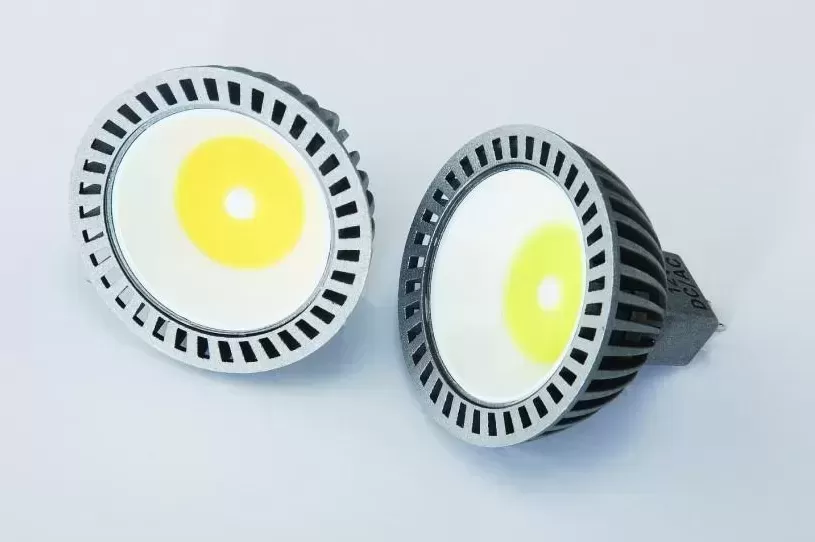
- General Architectural and Commercial Lighting: Standard downlights, troffers, and LED tubes operate well within the thermal limits of silicone matrices.
- Cost-Sensitive Portable Devices: Battery-powered lights and
consumer indicators operate at minimal wattage, making the lower unit cost of
films an ideal choice.

Cost vs. Total Cost of Ownership (TCO)
A procurement evaluation must look beyond individual component unit costs. While phosphor films show a lower purchase price per square centimeter, that calculation shifts when evaluating high-power assemblies.
Phosphor films require complex, oversized thermal management to keep local temperatures below 120°C. You may need larger copper heat pipes, active thermoelectric coolers (TECs), or noisy cooling fans simply to stop the film from burning. The converter is cheaper, but the thermal enclosure, power budget, and warranty risk grow significantly.
In contrast, a phosphor ceramic manufactured by precision ceramic producers like CAS operates safely at elevated junction temperatures. This allows engineers to use smaller heatsinks and passive cooling blocks. The resulting system uses fewer mechanical components, weighs less, and avoids warranty expenses caused by field degradation.
| Performance Metric | Phosphor Ceramic | Phosphor Film |
|---|---|---|
| Thermal Conductivity | High (9 to 30 W/m·K) | Very Low (< 0.8 W/m·K) |
| Operating Temperature Limit | Up to 300°C (Material stable >1000°C) | 120°C to 150°C maximum |
| Power Density Tolerance | > 20 to 60 W/mm² | < 2 to 5 W/mm² |
| Degradation Mechanism | Slow reversible quenching | Irreversible polymer yellowing/charring |
| Lifespan Under High Load | 20,000 to 50,000+ hours | 500 to 3,000 hours |
| Initial Component Cost | Moderate to High | Low |
| System Thermal Design Burden | Low (High heat tolerance) | Extreme (Must keep cool) |
The Verdict: Which Should You Choose?
The choice between these two converter platforms comes down to excitation density and environmental demands:
Choose a phosphor film if your system runs standard LEDs, operates at power densities below 2 W/mm², targets consumer pricing levels, or requires flexible shapes across large surfaces.
Choose a phosphor ceramic if you are using blue lasers, ultra-high-flux LED arrays, or high-luminance optical designs. For automotive headlights, high-lumen projectors, and industrial searchlights, ceramic converters offer the only viable thermal pathway to ensure stable, long-lasting performance.
Frequently Asked Questions (FAQ)
Q1: Can a phosphor ceramic completely replace a phosphor film in
existing LED products?
A1: Yes, in terms of optical physics, but it
is rarely cost-effective for standard, low-power consumer LEDs. Phosphor
ceramics are engineered specifically for demanding, high-flux environments.
Using them in low-power residential downlights provides no real performance
benefit over standard films, while adding unnecessary material costs.
Q2: What is the absolute maximum temperature a phosphor ceramic can
endure?
A2: The inorganic crystalline structure of a YAG-based
phosphor ceramic remains physically stable well above 1000°C without melting.
However, to avoid severe reversible thermal quenching and maintain high luminous
efficiency, engineers typically design cooling systems to keep the working
interface below 200°C to 250°C during continuous laser operation.
Q3: Why do phosphor films turn black or crack during laser
testing?
A3: This failure stems from localized thermal runaway. The
organic silicone or resin carrier has poor thermal conductivity. Stokes-shift
heat builds up in the phosphor particles and transfers directly into the
adjacent polymer chains. Once local temperatures exceed 200°C, the polymer
carbonizes. The resulting black carbon absorbs laser energy instead of
transmitting it, causing rapid burning and mechanical cracking.
Q4: How do optical engineers mount phosphor ceramics to
heatsinks?
A4: Because phosphor ceramics are all-inorganic,
engineers can metallize their perimeter or rear surface with thin-film stacks
(such as Ti/Pt/Au). This allows direct fluxless soldering (using AuSn or SAC
alloys) onto copper, aluminum nitride (AlN), or diamond substrates. Soldering
provides a low-resistance thermal bond that organic thermal pastes or adhesives
cannot match.
Q5: Can phosphor ceramics produce warm-white light with high Color
Rendering Index (CRI)?
A5: Yes. While standard Ce:YAG ceramics emit
a yellow-green light (yielding cool white when mixed with blue pump light),
advanced formulations integrate red-emitting ceramic phases or co-doping
elements like gadolinium (Gd), praseodymium (Pr), or nitride additives. These
composite ceramics achieve CRI values above 80 or 90 while maintaining high
thermal stability.
Work With CAS on Your Next High-Power Optical System
Transitioning from low-power prototypes to dependable high-power laser lighting requires reliable, proven materials. CAS designs, manufactures, and machines high-performance phosphor ceramic converters tailored to your exact wavelength, thickness, and thermal mounting specifications.
Our engineering team can help you select the optimal doping concentrations, calculate thermal saturation points, and provide pre-metallized ceramic plates ready for direct solder bonding. Contact CAS today to review your project specifications, request technical data sheets, or order custom test samples for your optical setup.