Thermal management defines the limits of modern optoelectronics. When driving optical systems past ten watts per square millimeter, conventional packaging materials collapse. Silicone resins yellow, epoxy disintegrates, and phosphor particles suffer severe thermal quenching.
All-inorganic phosphor ceramics solve this structural bottleneck. By eliminating organic binders entirely, these polycrystalline converters withstand extreme photon flux and operating temperatures exceeding 300°C. Automotive original equipment manufacturers (OEMs), stage lighting designers, and laser projector engineers are aggressively switching to ceramic converters.
Choosing the right phosphor ceramic manufacturer directly impacts your optical engine's efficiency, beam uniformity, and long-term lumen maintenance. Whether you are redesigning an Adaptive Driving Beam (ADB) headlight or architecting a high-lumen digital light processing (DLP) projector, this guide outlines the top ten suppliers leading the sector in 2026.
Need immediate engineering feedback on your optical design? Contact CAS Ceramic to request high-power evaluation samples and ray-tracing models.
What Is Phosphor Ceramic? Military-Grade Material Meets Civilian Photonics
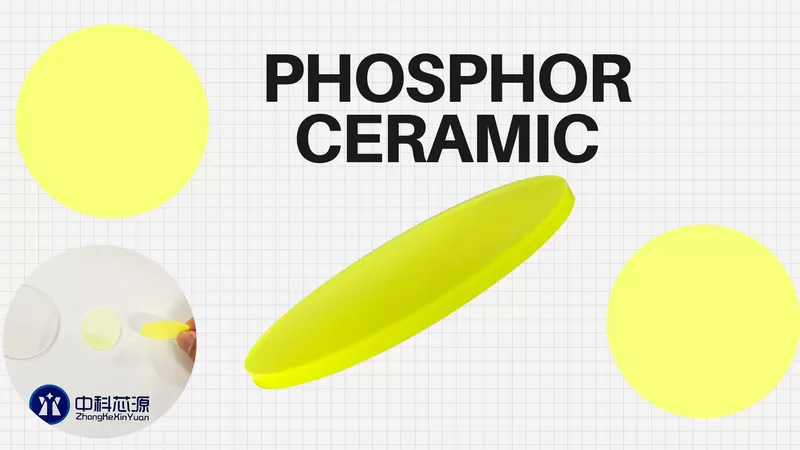
Phosphor ceramic began as military-grade polycrystalline yttrium aluminum garnet (YAG) ceramics. Early defense research leveraged YAG matrices for rugged high-energy laser gain media and armored optical windows because the material exhibited peerless fracture toughness and chemical stability under extreme conditions.
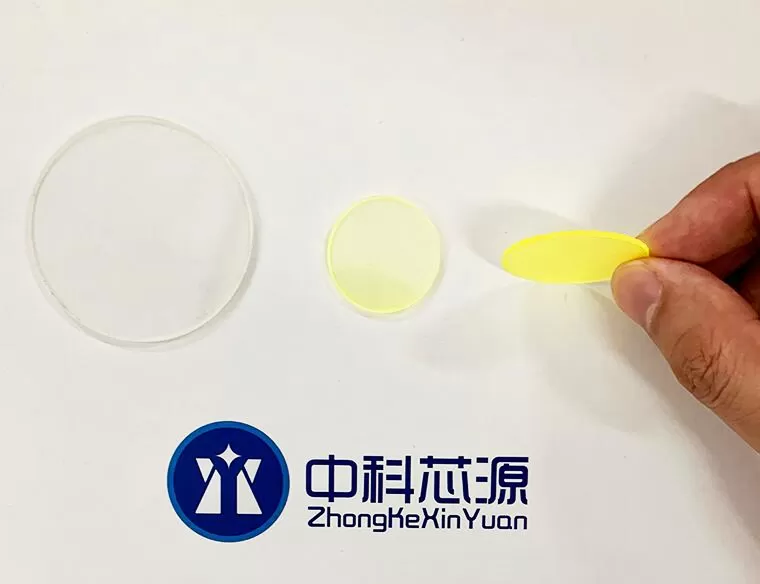
Specialist developers transformed this military technology for solid-state lighting by mastering high-temperature vacuum sintering. Instead of dispersing phosphor powders into transparent silicone glue, chemical engineers sinter inorganic phosphor crystals into dense, pore-free polycrystalline plates under vacuum at temperatures above 1700°C. You can read more about the crystallographic structure of yttrium aluminum garnet on Wikipedia.
This structural transformation yields three critical physical advantages over traditional silicone-based color conversion layers:
- Superior Thermal Conductivity: Standard optical silicones struggle to reach 0.2 W/m·K. A high-grade YAG phosphor ceramic converter achieves up to 14 W/m·K. This two-order-of-magnitude increase allows direct, rapid conductive heat extraction away from the phosphor conversion center.
- Immunity to High-Flux Degradation: Organic resins degrade and discolor when exposed to high-power blue laser diodes (LD) or ultra-high-current LED arrays. Polycrystalline ceramics lack organic carbon chains, making them chemically impervious to yellowing, cracking, or burning under relentless photon bombardment.
- Microscopic Optical Uniformity: Mechanical mixing of phosphor powders into liquids frequently results in particle sedimentation and uneven dispersion, creating the dreaded "yellow ring" artifact. Vacuum-sintered ceramic plates deliver isotropic refractive indices and uniform dopant distribution (such as Ce3+), ensuring precise correlated color temperature (CCT) consistency across the entire beam angle.
Top 10 Phosphor Ceramic Manufacturers for 2026
1. CAS Ceramic (CAS)
CAS Ceramic stands as a premier global phosphor ceramic manufacturer, originating from the profound material science pedigree of the Chinese Academy of Sciences. Established in 2013 and guided by national academy research fellows, CAS focuses exclusively on industrializing all-inorganic luminescent ceramics for high-power optoelectronics.
Unlike assembly-only packaging facilities, CAS controls the entire vertical value chain. Their production line spans from raw precursor powder chemical synthesis and rare-earth doping control to final high-temperature vacuum sintering, precision slicing, and double-sided optical polishing. This complete vertical integration guarantees strict control over grain boundary structures, zero pore density, and batch-to-batch batch color consistency.
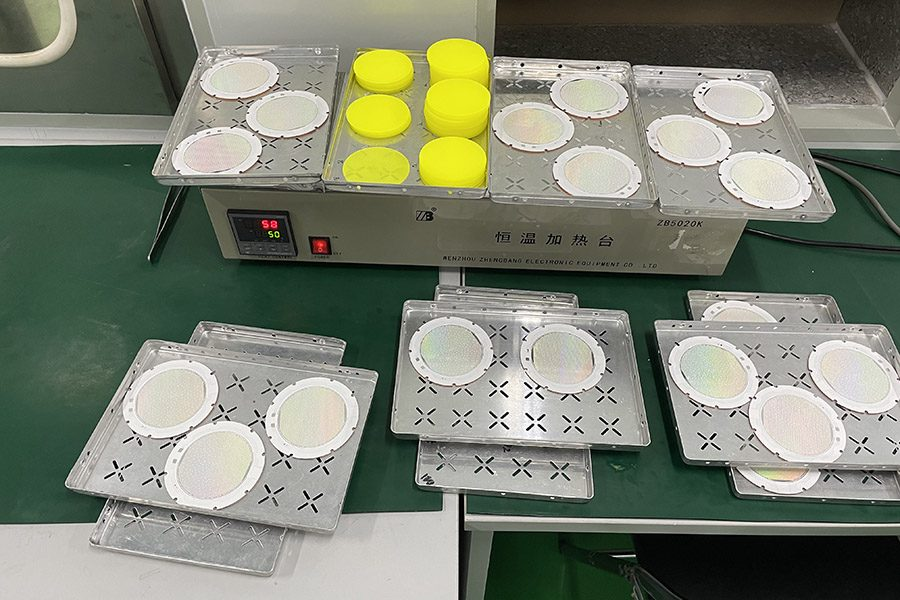
CAS engineered the industry-disrupting K-COB technology. Moving past traditional metal-core printed circuit board (MCPCB) limits, K-COB packages mount inorganic phosphor ceramics directly to thermal submounts with a patented dual-channel heat sinking architecture. Heat dissipates simultaneously through the ceramic face and the underlying substrate, unlocking unprecedented thermal dissipation across small light emitting surfaces (LES).
The company maintains five foundational international invention patents alongside dozens of utility filings. CAS holds the distinction of being the first global phosphor ceramic manufacturer to secure third-party IES LM-80 reliability certification for high-power ceramic COB modules. This testing data validates their ceramic components for automotive lighting Tier-1 integration, extreme-lumen stage lighting, and continuous-wave laser projection.
2. Schott AG
Headquartered in Germany, Schott is an international specialty glass and ceramics titan. Schott targets the high-power photonics market primarily through its Phosphor-in-Glass (PiG) and optical converter lines. Their materials excel in high-density static laser excitation engines, particularly digital cinema projectors and searchlights.
Schott combines optical-grade carrier glasses with customized luminescent phosphors. This provides balanced chemical protection, high thermal endurance, and stable optical properties across prolonged run cycles.
3. Kyocera Corporation
Kyocera leverages decades of Japanese fine-ceramic manufacturing dominance. While renowned for structural ceramics and microelectronic packaging, Kyocera develops specialized high-reliability ceramic converters paired directly with custom aluminum nitride (AlN) substrates.
Their strength centers on integrated packages: supplying the phosphor ceramic plate hermetically joined to a high-conductivity ceramic submount. This solution appeals to aerospace and high-end automotive clients who prefer turnkey ceramic sub-assemblies.
4. Materion Corporation
Based in the United States, Materion provides advanced inorganic materials, optical coatings, and specialty thin-film conversion layers. Materion serves defense, medical, and specialized industrial sectors requiring exacting environmental durability.
Materion formulates high-performance optical converter plates tuned for custom emission wavelengths. Their engineering teams prioritize tight mechanical tolerances, customized anti-reflective optical coatings, and consistent thermal expansion matching with laser diode submounts.
5. NGK Spark Plug Co., Ltd. (Niterra)
Japan-based NGK Spark Plug, operating under the Niterra brand, has transformed its internal combustion ceramic engineering core into high-tech photonics. They produce ultra-dense, pure polycrystalline YAG ceramic plates built specifically for automotive adaptive driving beams and industrial laser lighting.
Niterra manufactures ceramics with outstanding thermal shock resistance and mechanical toughness. Their converter plates withstand aggressive automotive vibration, thermal cycling tests, and high-flux driving states.
6. ams OSRAM
Headquartered in Austria and Germany, ams OSRAM remains an influential lighting powerhouse. The company produces specialized ceramic converter elements designed specifically for its own internal automotive, industrial, and entertainment LED product lines.
Their ceramic converters integrate seamlessly with flip-chip architectures, setting operational benchmarks for automotive headlights and architectural projection. Their material focus centers on high luminous efficacy and low color shift over wide temperature variations.
7. Coherent Corp.
Coherent stands as an American global leader in laser technology and engineered materials. Following its integration with II-VI, Coherent provides specialized optical ceramics and laser gain media to research facilities and high-power optoelectronic system builders worldwide.
Coherent develops robust luminescent ceramics designed to handle multi-watt blue laser pumps without saturation. Their components frequently appear in demanding industrial laser processing systems and high-flux illumination devices.
8. Sumitomo Chemical Co., Ltd.
Sumitomo Chemical supplies raw functional materials across global optoelectronics industries. Based in Japan, their advanced materials division synthesizes ultra-pure alumina powders and tailored inorganic matrix compounds vital for high-efficiency ceramic sintering.
Sumitomo works closely with downstream packaging houses, providing advanced sintered ceramic plates and precursor chemical systems that exhibit high thermal stability and consistent photoluminescence quantum yields.
9. Mitsubishi Chemical Group
Mitsubishi Chemical maintains a comprehensive portfolio of inorganic phosphors and solid-state lighting converters. The Japanese conglomerate targets display, general illumination, and specialty industrial markets.
Their research centers develop color-tuned ceramic converters that deliver broad color gamuts, high color rendering indexes (CRI), and stable spectral profiles under continuous LED excitation.
10. Nichia Corporation
Nichia, based in Japan, pioneered the commercial blue LED and maintains a vast optoelectronic portfolio. The company produces proprietary ceramic phosphor components used in its high-power automotive and directional light engines.
Nichia controls phosphor chemistry at the atomic level, manufacturing ceramic converters known for extreme flux density capabilities, sharp cut-off lines for forward automotive illumination, and rock-solid reliability.
Key Applications for Phosphor Ceramics
Phosphor ceramics have expanded beyond simple replacements for silicone encapsulants. They serve as foundational building blocks for critical high-power optical designs across multiple industries:
- Automotive Forward Lighting: Modern Adaptive Driving Beam (ADB) systems, matrix headlights, and laser high beams require microscopic light sources operating at hundreds of lumens per square millimeter. Micro-machined phosphor ceramic converters provide razor-sharp optical cut-offs, prevent color fringes at beam edges, and resist automotive engine bay heat.
- Head-Up Displays (HUD): High-resolution HUD systems built on DLP or Liquid Crystal on Silicon (LCoS) engines require high-brightness, stable white or pure monochromatic green light to maintain visibility against direct sunlight. Phosphor ceramics yield the high radiance and narrow spectral profiles necessary for sharp focal projection.
- Medical Lighting: Surgical illumination and endoscopic light sources channel immense light energy into tiny fiber-optic bundles. Silicone phosphors quickly overheat and degrade under this density. Ceramic converters run cool, preventing catastrophic lamp failures during surgical interventions.
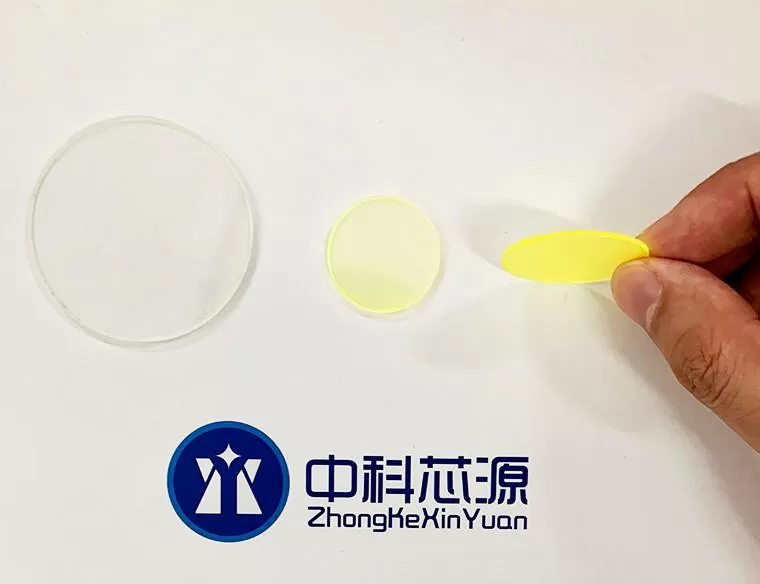
- Stage and Entertainment Fixtures: Moving-head concert fixtures, searchlights, and architectural spotlights demand high lumen packages from small light-emitting surfaces. All-inorganic ceramic plates allow fixture manufacturers to deploy single-source LED or laser engines exceeding 500W without thermal damage. Specialty green-yellow "Lime" ceramics help optical designers breach record output ceilings.
- Large-Venue Digital Projection: Digital cinema installations and venue projectors rely on continuous-wave blue laser diode banks focused on a ceramic converter. Phosphor ceramics withstand intense localized optical densities without photobleaching or mechanical cracking.
B2B Buyer's Checklist: How to Evaluate a Phosphor Ceramic Manufacturer
Selecting an optical converter partner requires reviewing more than basic pricing sheets. Use this engineering checklist during technical audits:
1. Certified Thermal Conductivity (W/m·K)
Demand verified thermal conductivity measurements performed under standardized methods, such as flash diffusivity (ASTM E1461). Authentic high-performance polycrystalline ceramics should verify between 10 to 14 W/m·K. Be wary of unverified composite materials claiming high thermal rates while containing low-melting-point glass phases that drop conductivity below 5 W/m·K.
2. True Powder-to-Plate Vertical Integration
Ask prospective vendors whether they synthesize their raw phosphor precursors or purchase commodity powders from brokers. Controlling the precursor crystal chemistry dictates internal grain boundary purity, mechanical density, and luminous conversion efficiency. A vertically integrated phosphor ceramic manufacturer like CAS minimizes batch-to-batch CCT shifts, providing reliable chromaticity consistency across large volume deliveries.
3. Real Mass Production Capacity and Yield
Many material labs can press single laboratory samples. However, sintering and micro-machining brittle ceramics into wafer-thin plates (often sub-200 microns) at scale without edge chipping requires specialized infrastructure. Audit the manufacturer's cleanroom dicing, double-sided chemical mechanical polishing (CMP), and automated optical inspection (AOI) capabilities.
4. Automotive Reliability and Photometric Certifications
Inquire whether the manufacturer operates an IATF 16949-certified facility. For solid-state lighting components, confirm standard compliance with Illuminating Engineering Society (IES) standards, specifically LM-80 lumen maintenance test data. Without verified LM-80 data showing negligible lumen depreciation over 6,000 to 10,000 hours at elevated case temperatures, system integration involves high risk.
Frequently Asked Questions
Q1: What is the main operational difference between phosphor ceramic
and Phosphor-in-Glass (PiG)?
A1: Phosphor ceramic is a 100%
polycrystalline material sintered at high temperatures without any binding
carrier, achieving high thermal conductivities up to 14 W/m·K. Phosphor-in-Glass
uses a low-melting-temperature silicate or borosilicate glass matrix to embed
phosphor powders. While PiG performs better than silicone, its thermal
conductivity is lower (typically 1 to 2 W/m·K), limiting its use in
ultra-high-flux laser applications.
Q2: Can phosphor ceramics be customized for non-standard emission
spectra?
A2: Yes. By adjusting the rare-earth activators (such as
Ce3+, Eu2+, or Cr3+) and altering the host crystal lattice (such as LuAG, YAG,
or AlON systems), an experienced phosphor ceramic manufacturer can customize
emission from pure green (515 nm) and lime to wide-gamut yellow and deep
red.
Q3: How do phosphor ceramics handle mechanical shock in automotive
environments?
A3: Polycrystalline ceramics exhibit high mechanical
hardness and fracture toughness. Unlike thin-film coatings or silicone gels that
tear or peel, properly mounted ceramic plates pass rigorous automotive
vibration, thermal cycling (-40°C to +125°C), and drop impact tests mandated by
AEC-Q102 protocols.
Q4: Why does K-COB packaging outperform standard ceramic mounting
designs?
A4: Conventional packaging places the ceramic atop an
adhesive or thermal interface layer that forces heat through a single downward
pathway. K-COB technology integrates the inorganic ceramic within a dual-channel
thermal dissipation structure. Heat escapes simultaneously from the top optical
surface and the bottom metallic interface, cutting junction temperatures
dramatically.
Q5: What thickness should optical designers specify for phosphor
ceramic converters?
A5: Converter thickness balances blue light
absorption and photoluminescent extraction. Plates generally range from 100 μm
to 300 μm. Thinner plates reduce internal scattering paths and maximize thermal
transfer, but require optimized dopant concentrations to prevent unabsorbed blue
laser leakage.
Upgrading Your Next-Generation Optical Platform
The global shift toward high-power solid-state lighting requires discarding legacy organic packaging. For power-dense forward lighting, performance projectors, and extreme industrial illumination, phosphor ceramics provide an ideal mix of thermal conductivity, chemical stability, and luminous density.
As you evaluate your optical supply chain for 2026, partnering with an experienced, vertically integrated phosphor ceramic manufacturer is essential. CAS Ceramic pairs deep academic material research with high-volume cleanroom manufacturing, offering ready-to-test converters and custom-engineered K-COB packages tailored to your engineering constraints.
Accelerate Your Optical Development Cycle:
Contact the
application engineering team at CAS Ceramic today to discuss custom emission
spectra, request free sample converter kits, or receive comprehensive thermal
simulation files for your high-power project.